Direct mail response rates are one of the clearest signs of whether a campaign is working. For UK businesses, they matter because they show how well your offer, targeting, and messaging are turning recipients into real actions, not just impressions.
If you are building a direct mail content cluster, this article should support related pages such as What Is Direct Mail Marketing?, How to Build a Targeted Mailing List, Personalised Direct Mail Campaigns, and
Direct Mail vs Email Marketing. It should also work as a strong SEO page for search intent around direct mail response rates in the UK, the average direct mail response rate, and how to improve direct mail ROI.
What Is a Direct Mail Response Rate?
A
direct mail response rate is the percentage of people who take a desired action after receiving your mail. That action might be visiting your website, scanning a QR code, calling your business, using a coupon code, or making a purchase.
The formula is simple:
Response Rate = (Number of Responses ÷ Total Mail Sent) × 100
For example, if you send 1,000 postcards and 50 people respond, your response rate is 5%. That number becomes more useful when you compare it with your campaign cost, conversion rate, and final revenue.
Average Direct Mail Response Rates in the UK
Average direct mail response rates vary depending on the audience and campaign quality, but direct mail generally performs strongly when compared with many digital channels. Well-targeted campaigns often achieve response rates in the 4% to 9% range, while colder audiences usually perform lower.
That gap matters because a response rate is not just a vanity metric. It shows how effectively your campaign moved people from awareness to action, which directly affects leads, conversions, and ROI.
For UK businesses, this makes direct mail especially valuable in local and postcode-based campaigns where the audience is more likely to be relevant.
Why Direct Mail Often Outperforms Digital
Direct mail has several built-in advantages that help improve response rates. The first is physical presence. A printed piece is tangible, so recipients can see it, hold it, and come back to it later.
The second is lower competition. Email inboxes and social feeds are crowded, but physical mailboxes usually contain far fewer marketing messages. That makes your campaign more noticeable.
The third is trust. Printed materials often feel more credible and professional than a digital ad or cold email. When the message feels more serious and intentional, people are more likely to respond.
What Affects Response Rates
Response rates are not fixed. They depend on several campaign factors, and improving even one of them can make a big difference.
Audience Quality
The better the targeting, the better the results. If your offer is sent to people who are already likely to need it, your response rate will usually rise. If the list is too broad or irrelevant, performance drops quickly.
Offer Strength
The offer itself plays a major role. Discounts, free consultations, limited-time deals, and high-value bonuses tend to perform better than generic messages. The stronger the reason to act now, the higher the response rate tends to be.
Design and Messaging
A clear, simple, visually appealing mail piece performs better than cluttered or confusing creative. The headline should explain the offer quickly, and the call-to-action should make the next step obvious.
Personalisation
Personalised campaigns usually perform better because they feel more relevant. Even small touches like a recipient’s name, location, or previous purchase history can improve engagement.
Timing
Timing can strongly influence results. Seasonal promotions, local events, payday periods, and holiday campaigns often perform better than poorly timed mail drops.
What Counts as a Good Response Rate?
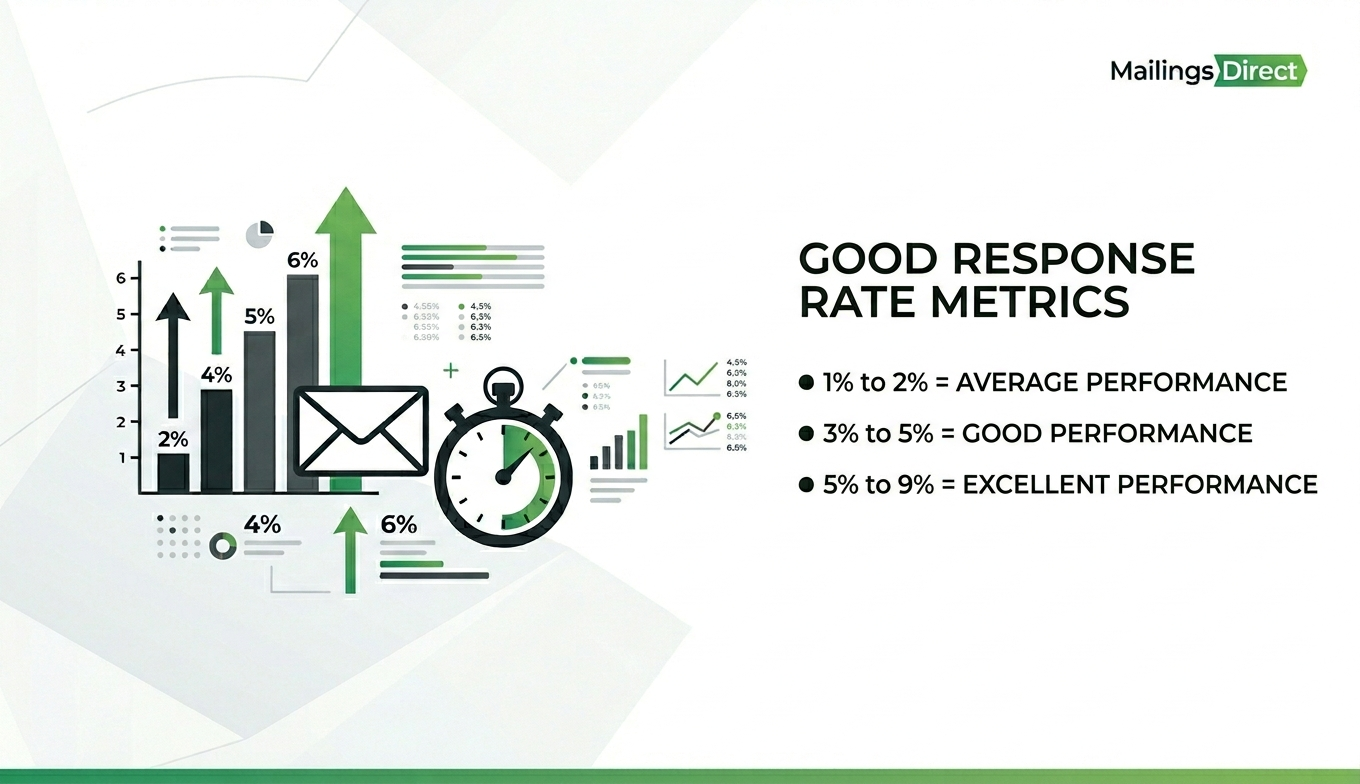
A “good” response rate depends on your campaign goals, but in general:
- 1% to 2% = average performance.
- 3% to 5% = good performance.
- 5% to 9% = excellent performance.
For highly targeted campaigns, especially those sent to existing customers or warm prospects, response rates can be even higher. What matters most is not just the response rate itself, but whether it produces profitable customers.
Direct Mail vs Email Response Rates
Direct mail and email are often compared because both can be used to promote offers, but they behave very differently.
Email marketing usually has lower response rates because inboxes are crowded, messages are easy to ignore, and spam filtering can reduce visibility. Direct mail, by contrast, tends to generate stronger engagement because it is physical, more visible, and often perceived as more trustworthy.
That does not mean email is unimportant. Email is faster, cheaper, and very useful for follow-up. But if your goal is to drive strong immediate attention from a targeted audience, direct mail often has the advantage.
This is a strong place to link internally to Direct Mail vs Email Marketing: Which Delivers Better ROI?
How Response Rates Affect ROI
Response rates are closely tied to return on investment. A higher response rate usually means more leads, more conversions, and more revenue from the same mailing volume.
However, response rate alone does not tell the full story. A campaign with a lower response rate can still outperform another if the leads are higher quality or if the average order value is stronger. That is why businesses should track both response rate and conversion rate together.
The real question is not just, “How many people responded?” It is also, “How many of those responses became paying customers?”
How to Improve Direct Mail Response Rates
If you want better results from direct mail, focus on the following areas:
Improve Targeting
Use high-quality mailing lists and segment your audience carefully. The more relevant the offer, the more likely people are to respond.
This is a good place to link to How to Build a Targeted Mailing List for Direct Mail Campaigns.
Strengthen the Offer
Make the offer valuable and time-sensitive. People respond more when they believe they are getting something useful or exclusive.
Use Clear Calls-to-Action
Tell readers exactly what to do next. Whether it is visiting a website, using a code, or calling a number, the action should be simple and obvious.
Personalise the Message
Personalisation increases relevance. A message that refers to location, purchase history, or customer type can feel much more compelling than a generic promotion.
This is a natural place to link to Personalised Direct Mail Campaigns.
Test and Refine
Test different headlines, images, offers, formats, and mailing segments. Small improvements can lead to much stronger campaign performance over time.
Combine with Digital
Direct mail works even better when paired with digital marketing. QR codes, personalised URLs, and email follow-ups make it easier to track results and continue the customer journey.
This is a good place to link to How to Combine Direct Mail with Digital Marketing.
Common Mistakes That Lower Response Rates
Poor targeting is one of the biggest reasons direct mail campaigns fail. If the message reaches the wrong audience, even a strong offer will struggle.
Weak calls-to-action also reduce performance. If the recipient does not know what to do next, the campaign loses momentum.
Other mistakes include cluttered design, no tracking, and generic messaging. A campaign should always be easy to read, easy to act on, and easy to measure.
Real-World Example
Imagine a local business sends 2,000 postcards to a carefully targeted postcode list. If 100 people respond, the campaign has a 5% response rate. If 40 of those become customers, the campaign is producing both engagement and revenue.
That kind of result shows why direct mail remains valuable in UK marketing. It may cost more per send than email, but the quality of attention often makes the investment worthwhile.
How Direct Mail Fits Into Your Strategy
Direct mail should not sit in isolation. It works best as part of a broader marketing system that includes email, search, social media, and retargeting.
You can use direct mail to create awareness, email to nurture interest, and digital ads to reinforce the message. This multi-touch approach often improves overall campaign performance and gives your business more chances to convert the same audience.
FAQs
Q. What is the average direct mail response rate in the UK?
Average response rates for well-targeted direct mail campaigns often fall in the 4% to 9% range, although results vary by audience, offer, and execution.
Q. Is direct mail better than email for response rates?
Direct mail often delivers higher response rates because it is physical, more visible, and less crowded than email. Email is still useful for low-cost follow-up and automation.
Q. What is considered a good direct mail response rate?
Anything above 3% is often considered good, while 5% or more is usually seen as excellent, especially for targeted campaigns.
Q. How can I track direct mail results?
You can track results using QR codes, unique promo codes, personalised URLs, dedicated phone numbers, and campaign-specific landing pages.
Q. Why do response rates matter so much?
Response rates help you understand how well your campaign is turning recipients into action. They are one of the clearest indicators of campaign effectiveness and ROI.
Final Thoughts
Direct mail response rates remain one of the strongest reasons businesses continue to invest in this channel. When targeting is strong and the offer is relevant, direct mail can deliver meaningful engagement and strong returns.
For UK businesses, the key is not just sending mail, but sending the right message to the right audience at the right time. When you do that, direct mail can become one of the most effective parts of your marketing mix.
