
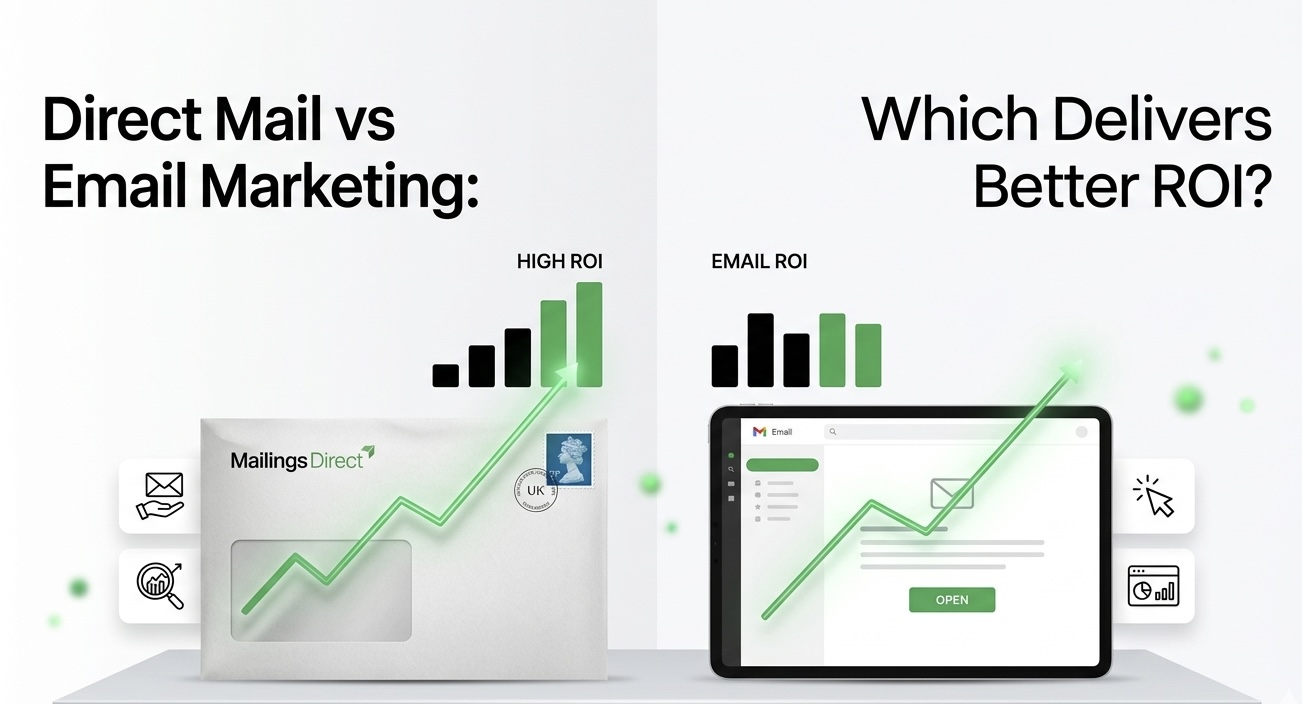
Businesses today have more channels than ever to reach customers, but two of the most effective remain direct mail marketing and email marketing. Both can generate strong results, yet they work in very different ways. If your goal is to decide which channel delivers the better return on investment (ROI), the answer depends on your audience, offer, budget, and campaign objective.
Email marketing is usually cheaper, faster, and easier to scale, while direct mail often delivers stronger engagement, better trust, and more memorable brand interactions. For many UK businesses, the highest ROI comes from using both channels together rather than treating them as competitors.
What Is Direct Mail Marketing?
Direct mail marketing is the practice of sending printed promotional materials directly to a targeted audience through postal services such as Royal Mail. Common formats include postcards, brochures, flyers, and personalised letters.
Direct mail is especially useful for local campaigns, premium offers, and audience segments where trust and attention matter. Because the message is physical, it can feel more credible and can stay visible in the home or office longer than a digital message.
What Is Email Marketing?
Email marketing is a digital strategy where businesses send promotional or informational messages directly to subscribers via email. These campaigns can include newsletters, special offers, product updates, and personalised recommendations.
Email remains popular because it is inexpensive to send, quick to launch, and easy to automate. It is often used for lead nurturing, customer retention, and repeat sales, especially when businesses already have a strong list.
How ROI Is Measured
ROI measures how much revenue a campaign generates compared to its cost. The basic formula is: ROI = (Revenue – Cost) / Cost.
When comparing direct mail and email, cost alone is not enough. A cheaper campaign may produce weaker responses, while a more expensive campaign may generate better-quality conversions and higher customer value.
Direct Mail vs Email Marketing
Factor | Direct Mail | Email Marketing |
Format |
Physical |
Digital |
Cost |
Higher upfront |
Lower upfront |
Engagement |
Often higher |
Often lower due to inbox noise |
Trust |
Usually stronger |
More variable |
Speed |
Slower |
Instant |
Scalability |
Moderate |
Very high |
Best use case |
Targeted, high-value campaigns |
Frequent, low-cost communication |
Direct mail continues to outperform email in response rates, especially when campaigns are personalised and tightly targeted. At the same time, email remains the more
cost-efficient channel for mass communication and automation.
Cost Comparison
Email marketing usually has the lowest entry cost because there are no printing or postage expenses. Businesses mainly pay for software, creative work, and list management, which makes email highly scalable for frequent campaigns.
Direct mail requires design, print production, and postage, so the upfront investment is higher. However, the stronger engagement and response rates can make the higher spend worthwhile, particularly for local, high-value, or premium campaigns.
Engagement and Attention
Direct mail often wins when the goal is to capture attention. Physical mail has a tangible presence, and people are more likely to notice, handle, and remember it than a crowded email. Some industry sources note that direct mail can achieve open or engagement rates far above email, which helps explain its strong performance in ROI-driven campaigns.
Email engagement is more fragile because of inbox competition, spam filtering, and short attention spans. Even well-written emails can be ignored if the audience is not already warm or the timing is off.
Response and Conversion
Direct mail tends to produce stronger response quality when the list is well targeted. The format feels more deliberate and personal, which can improve trust and make the
call-to-action more compelling.
Email marketing can still convert well, especially for existing customers and subscribers who already know the brand. It is particularly effective for abandoned cart flows, nurture sequences, and time-sensitive offers where instant delivery matters.
Targeting Strengths
Direct mail is especially strong for geographic targeting. Businesses can mail by postcode, neighbourhood, household type, or business sector, which makes it ideal for local campaigns and area-specific promotions.
Email targeting is more behavioural. Businesses can segment by open history, purchase behaviour, website activity, or engagement level. This makes email excellent for lifecycle marketing and personalised automation.
Trust and Brand Credibility
Printed mail often feels more credible because it requires more effort and investment from the sender. That premium feel can improve trust, especially for businesses selling high-value services or products.
Email can feel less trustworthy when recipients receive too many promotional messages each day. Spam concerns and overused templates can reduce confidence, especially in cold outreach or broad promotional campaigns.
Which Channel Delivers Better ROI?
The short answer is: it depends on your goals.
Email marketing usually delivers better ROI when the goal is low-cost communication, high frequency, automation, and scale. It is especially strong for retention, repeat sales, and nurturing existing relationships.
Direct mail usually delivers better ROI when the goal is attention, trust, and response quality. It is often the stronger option for local campaigns, high-value audiences, and offers that need to stand out from digital clutter.
When Email Works Best
Email marketing is typically the better choice when:
- You already have a strong subscriber
- You need to send messages
- You want to keep costs
- You want automation and repeat
- Your campaign is aimed at existing
Because email is so inexpensive to send, it can generate excellent ROI when the audience is engaged and the offer is relevant.
When Direct Mail Works Best
Direct mail is usually more effective when:
- You are targeting a specific local
- You want to reach high-value
- You need stronger trust and
- You are promoting a premium or complex
- You want to stand out from digital
For these campaigns, the extra cost of print and postage can be justified by stronger engagement and better-quality conversions.
The Best Strategy Is to Combine Both

The strongest results often come from using direct mail and email together. A direct mail piece can create attention and awareness, while email can follow up with reminders, educational content, or a limited-time offer.
For example, a retailer could send a postcard with a QR code, then use email to reinforce the message and encourage conversion. This kind of multi-channel approach can improve overall campaign performance and help businesses reach customers at more than one touchpoint.
Best Practices for Better ROI
To improve ROI across both channels, focus on these fundamentals:
- Use clear, specific calls-to-
- Personalise the message where
- Segment your audience
- Track every response using codes, URLs, or
- Test creative, offers, and timing before
Common Mistakes to Avoid
Many campaigns fail because of weak targeting, vague messaging, or poor follow-up. Another common mistake is measuring only cost, rather than actual revenue and customer value.
A cheaper campaign is not always the better one if it fails to convert. The real goal is profitable growth, not just lower spend.
FAQs
Is direct mail better than email marketing?
Direct mail is often better for trust, attention, and response quality, while email is usually better for low-cost, high-frequency communication. The better choice depends on your goals.
Which has the higher ROI: direct mail or email?
Email often wins on cost efficiency, but direct mail can deliver stronger ROI for targeted, high-value, or local campaigns. Many businesses get the best results by combining both channels.
Why does direct mail still work in the UK?
Direct mail still works because it stands out in crowded markets, feels more tangible, and can be targeted by postcode and location with precision.
How can I track ROI from direct mail?
Use QR codes, unique discount codes, personalised URLs, and dedicated phone numbers to measure responses and conversions accurately.
Should small businesses use both direct mail and email?
Yes. Small businesses often benefit from using direct mail to attract attention and email to follow up, nurture leads, and increase conversion rates.
Final Thoughts
When comparing direct mail vs email marketing, there is no universal winner. Email is usually the more affordable and scalable option, while direct mail often produces stronger engagement, trust, and memorability.
For UK businesses, the best ROI often comes from combining both channels into one integrated strategy. Direct mail can help you stand out, and email can help you stay top of mind until the customer is ready to act.