
Direct mail marketing in the UK remains one of the most effective ways for businesses to reach potential customers through targeted, physical communication. While digital marketing channels such as email, social media, and online advertising dominate modern marketing strategies, direct mail continues to produce strong engagement and response rates for businesses across many industries.
For UK companies looking to generate leads, increase brand awareness, or drive local sales, direct mail marketing offers a powerful way to reach audiences in a tangible, memorable way.
This comprehensive guide explains everything businesses need to know about direct mail marketing in the UK, including how it works, its benefits, campaign strategies, best practices, and how to measure success.
Table of Contents
- What Is Direct Mail Marketing
- Why Direct Mail Marketing Still Works in the UK
- Types of Direct Mail Campaigns
- Key Benefits of Direct Mail Marketing
- Direct Mail Marketing Statistics
- How to Plan a Successful Direct Mail Campaign
- Direct Mail vs Digital Marketing
- Industries That Benefit from Direct Mail
- Direct Mail Marketing Best Practices
- The Future of Direct Mail Marketing
- Frequently Asked Questions
- Getting Started with Direct Mail Campaigns
What Is Direct Mail Marketing?

Direct mail marketing is a form of targeted advertising where businesses send printed promotional materials directly to individuals or companies through the postal system. This method allows for precise delivery to specific addresses, making it ideal for personalised outreach rather than mass broadcasting.
These materials can include postcards for quick visual impact, letters for detailed narratives, brochures for in-depth product info, flyers for event promotions, catalogues for product showcases, and promotional packages like branded items or samples that encourage handling and retention. Each format serves unique purposes: postcards grab attention instantly without envelopes, while packages create a “wow” unboxing experience that boosts engagement by up to 40%.
Unlike traditional advertising methods such as television or billboards, direct mail marketing focuses on reaching a specific audience rather than broadcasting a message to the general public. In the United Kingdom, many businesses distribute marketing materials through postal services such as Royal Mail, which offers specialised bulk mailing solutions designed for business marketing campaigns, including discounted rates for volumes over 500 items.
Direct mail can be used for many marketing purposes, including promoting products with limited-time offers, generating leads via reply cards or QR codes, announcing events like webinars or store openings, and increasing brand awareness through consistent “drip” campaigns. For a beginner’s overview, see our cluster article: What Is Direct Mail Marketing? A Beginner’s Guide.
Why Direct Mail Marketing Still Works in the UK?
Despite the growth of digital marketing channels, direct mail remains highly effective for several reasons, consistently outperforming email in response rates (4-9% vs. 0.1-0.2%).
Less Competition for Attention: Consumers receive hundreds of digital marketing messages every day—emails alone average 120 per day—while physical mailboxes are far less crowded, allowing direct mail pieces to stand out immediately upon arrival. In the UK, with 32 million households, this scarcity creates a premium attention slot.
Higher Engagement: People typically spend more time interacting with physical materials compared to digital advertisements—up to 53% longer, according to tactile response studies—printed content can be read at a slower pace, shared with others (e.g., family members discussing a restaurant flyer), or saved for later reference on noticeboards.
Better Brand Recall: Studies, including fMRI brain scans, have shown that physical marketing materials create stronger emotional engagement and memory retention compared with many digital formats, with recall rates 70% higher due to multisensory activation (touch, sight, even smell for scented mailers).
Increased Trust: Consumers often perceive printed marketing materials as more credible and trustworthy than online advertisements, which suffer from ad-blockers and fraud concerns; 69% of UK consumers trust print more, making it perfect for high-stakes sectors like finance. For ROI comparisons, check Direct Mail vs Email Marketing: Which Delivers Better ROI?.
Types of Direct Mail Campaigns
Businesses can choose from several direct mail formats depending on their marketing goals, budget, and audience preferences—costs range from £0.20 for postcards to £2+ for packages.
Postcards: Postcards are one of the most popular forms of direct mail marketing because they are affordable (£0.30-£0.50/unit at scale), visually appealing with full-color fronts, and easy to read without opening an envelope, achieving open rates near 100%. They work particularly well for local promotions like “Neighbourhood Sale,” seasonal sales such as Black Friday deals, product launches with teaser images, and event announcements like grand openings; track success with QR codes. Dive deeper in How to Design a High-Converting Direct Mail Postcard.
Letters: Letters allow businesses to deliver a more personal and detailed message via envelopes, which add intrigue and privacy, often including lift notes (teaser inserts) that boost responses by 20%. They are commonly used for professional services like consultancy pitches, financial institutions offering mortgages, B2B marketing campaigns targeting SMEs, and membership offers with personalized terms. See Personalised Direct Mail Campaigns: How They Increase Response Rates.
Flyers: Flyers are commonly used for large-scale marketing campaigns, particularly by local businesses, as A4/A5 sheets that fit easily in doors or letterboxes. They are effective for promoting restaurant offers like “Buy One Get One Free,” retail discounts such as clearance sales, and service announcements for plumbers or electricians; compare options in Flyer vs Postcard Marketing: Which One Works Better?.
Brochures: Brochures allow businesses to provide detailed information about products or services in tri-fold or bi-fold formats (4-12 pages), with high-quality images and specs. Industries that commonly use brochures include real estate for property portfolios, travel companies showcasing holiday packages, healthcare providers detailing treatments, and education services promoting courses.
Catalogues: Retail businesses often use catalogues to showcase a wide range of products—20-100+ pages with thumb indexes—encouraging repeat purchases and increasing average order value by 15-30%. They’re staples for fashion, home goods, and gardening brands, often mailed quarterly to loyalty lists.
Promotional Packages (Dimensional Mail): These “lumpy” items like branded mugs or product samples create urgency (recipients shake packages), yielding 28-40% response rates for high-value leads in B2B or luxury retail.
Key Benefits of Direct Mail Marketing
Direct mail offers several advantages that make it a valuable marketing channel, with UK ROI averaging £12-£29 per £1 spent.
Highly Targeted Marketing: Businesses can target audiences using data such as geographic location (postcode-level via Royal Mail), demographics (age, gender via Mosaic classification), household income (from Experian data), business sector (SIC codes), and purchase behaviour (RFM analysis from CRM). A targeted mailing list ensures marketing materials reach the most relevant audience, doubling response rates. Learn more in How to Build a Targeted Mailing List for Direct Mail Campaigns.
Measurable Campaign Performance: Direct mail campaigns can include tracking tools such as QR codes linking to landing pages, promotional discount codes for attribution, personalised URLs (PURLs like yourname.com/offer), and dedicated phone numbers via call-tracking software. These tools allow businesses to measure campaign effectiveness down to the individual level. See Average Direct Mail Response Rates and What They Mean for Your Business.
Strong Local Marketing Results: Direct mail is particularly effective for businesses targeting specific geographic areas, such as sending “New Neighbour” postcards to recent movers in a postcode or estate agents farming SE1 for listings.
High Response Rates: Direct mail campaigns often achieve higher response rates than many digital advertising channels (4-9% vs. email’s 0.12%), especially when well-targeted and personalised, with house lists hitting 9.35%. Explore 10 Benefits of Direct Mail Marketing Services for Businesses.
Direct Mail Marketing Statistics
- Direct mail remains an important marketing channel because of its measurable performance, backed by 2025 DMA data showing sustained growth.
- Direct mail response rates can reach 4–9% depending on targeting and audience quality (house lists: 9.35%; prospects: 4.9%; email: 0.12%).
- Physical marketing materials often generate higher brand recall compared with digital ads (70% lift; 57% of millennials respond to mail).
- Many consumers say they trust printed marketing materials more than online advertisements (69% preference; 76% make purchases from received mail).
- ROI stands at 29:1 for targeted campaigns, with 62% of UK brands increasing budgets post-2025. These results demonstrate why direct mail continues to be widely used by businesses across the UK.
How to Plan a Successful Direct Mail Campaign
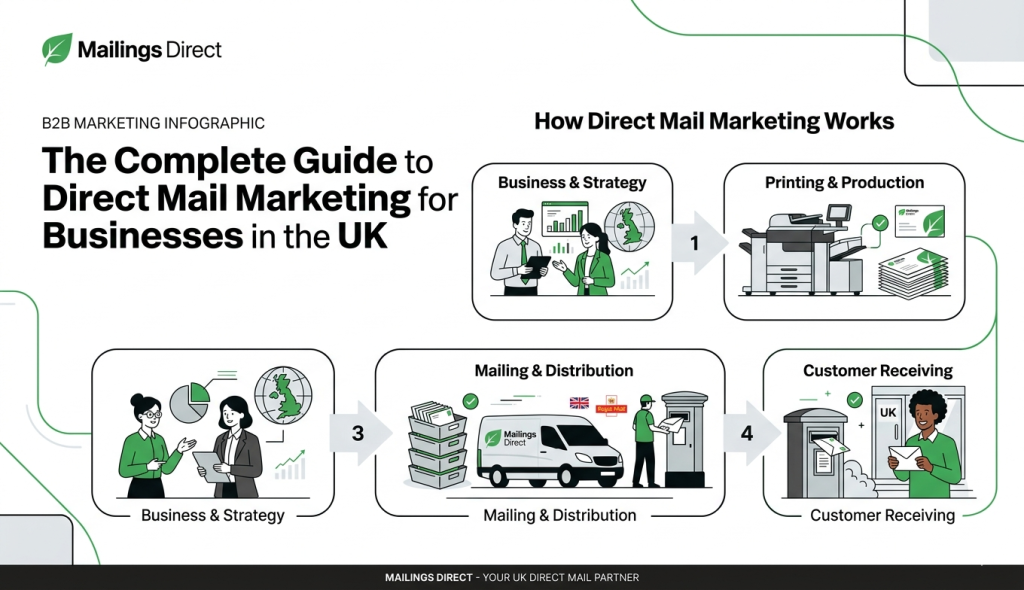
Running a successful direct mail campaign requires careful planning and execution. Below are the main steps involved—follow our full How to Plan a Successful Direct Mail Campaign Step-by-Step.
Step 1: Define Your Campaign Goals: Start by identifying the primary objective of the campaign, using SMART criteria (Specific, Measurable, Achievable, Relevant, Time-bound). Common goals include generating leads (e.g., 200 appointments), promoting a new product with redemption targets, increasing website visits via QR traffic, and encouraging store visits with geo-fenced offers.
Step 2: Identify the Target Audience: Understanding the target audience helps businesses tailor their messaging effectively. Important factors to consider include age group (e.g., 25-44 for tech gadgets), location (London postcodes for urban services), industry type (retail vs. B2B), and buying behaviour (frequent purchasers from loyalty data). Use tools like The Ultimate Direct Mail Campaign Checklist for Marketers.
Step 3: Build or Acquire a Mailing List: A high-quality mailing list ensures the campaign reaches the right recipients—aim for <2% bad addresses. Mailing lists may come from customer databases (CRM exports), postcode targeting (Royal Mail tools), or business directories (e.g., Yell.com). Weigh options in Should You Buy Mailing Lists? Pros, Cons, and Alternatives; detail segmentation in Mailing List Segmentation Strategies for Better Campaign Results.
Step 4: Design the Marketing Material: An effective direct mail piece should include a clear headline (e.g., “Unlock Your £200 Saving”), engaging visuals (high-res photos), concise messaging (<150 words), and a strong call-to-action (e.g., “Scan Now”). Apply 12 Direct Mail Design Best Practices That Increase Conversions and Print Marketing Design Tips Every Business Should Know.
Step 5: Print the Campaign Materials: Professional printing ensures that marketing materials represent the brand effectively. Key considerations include paper type (130-170gsm silk for postcards), colour quality (CMYK full-colour), printing finish (matte lamination for durability), and eco-options (FSC-certified). Explore Best Paper Types and Finishes for Direct Mail Campaigns.
Step 6: Distribute the Mail: After printing, the materials are distributed through postal networks using bulk mailing solutions like Royal Mail Mailsort or CleanMail for savings up to 40%. Full guide: A Complete Guide to Royal Mail Bulk Postage Discounts and How Bulk Mailing Services Work for Businesses.
Direct Mail vs Digital Marketing
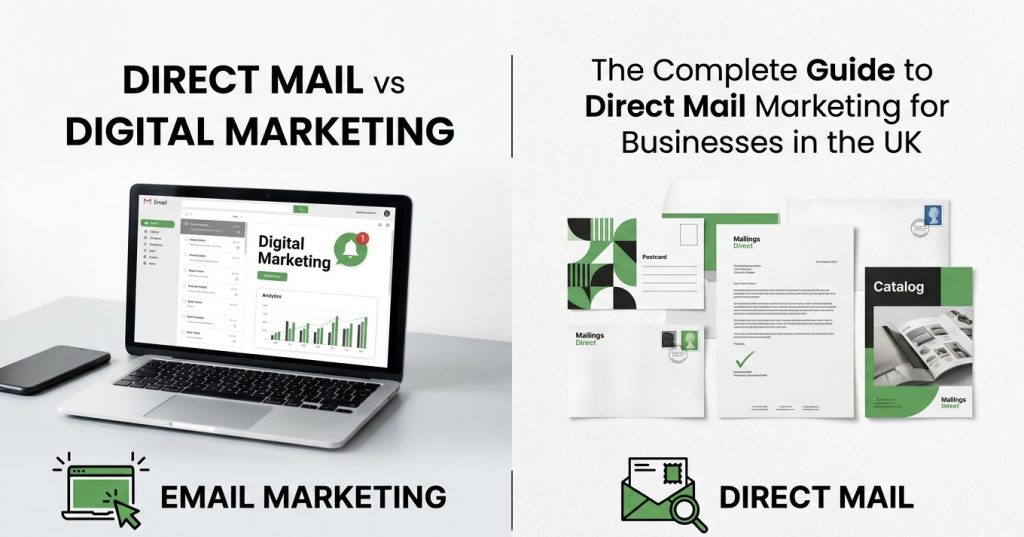
Direct mail and digital marketing are often compared, but they are most effective when used together for omnichannel synergy—e.g., mail triggers email retargeting for 3x lifts.
Digital marketing offers benefits such as fast campaign deployment (hours vs. weeks), detailed analytics (real-time dashboards), and lower distribution costs (£0.01/email).
However, direct mail provides advantages, including higher engagement (53% more time spent), stronger brand credibility (69% trust), and reduced advertising competition (uncrowded letterboxes). Combining both channels allows businesses to create powerful multi-channel marketing strategies. Detailed comparison in How to Combine Direct Mail with Digital Marketing.
Aspect | Direct Mail | Digital Marketing |
Response Rate | 4-9% | 0.1-2% |
Cost per piece/Impression | £0.50-£2 | £0.01-£0.50 |
Engagement | High (tactile, shared) | Low (skimmable) |
Targeting | Postcode/demographic | Behavioural/cookies |
Trust & Recall | Superior (69%/70%) | Variable |
Industries That Benefit from Direct Mail
Direct mail marketing works well across many industries, with tailored tactics driving leads and loyalty.
Real Estate: Estate agents use direct mail to promote property listings (e.g., “Just Sold” postcards) and connect with homeowners via farming campaigns, generating 12% inquiry rates. Full strategies: Direct Mail Marketing for Real Estate: Strategies That Generate Leads.
Healthcare: Healthcare providers often use direct mail to inform patients about new services (e.g., vaccination reminders), flu shot promotions, or wellness checks, reducing no-shows by 30%. See Direct Mail Marketing for Healthcare Clinics and Practices.
Retail: Retailers frequently promote seasonal offers (holiday catalogues) and product launches through direct mail campaigns to boost store traffic and AOV by 25%. Guide: How Retail Businesses Use Direct Mail to Increase Store Traffic.
Professional Services: Law firms, accountants, and consultants use direct mail to build trust and attract new clients with educational pieces like tax guides.
Dentists/Non-Profits: Dentists acquire patients via hygiene reminders; charities see 40% donation lifts. Check Direct Mail Marketing for Dentists: Patient Acquisition Strategies.
Direct Mail Marketing Best Practices
Businesses can improve campaign results by following proven marketing strategies, ensuring GDPR compliance via opt-outs.
Personalise Your Campaign: Personalised messages (e.g., “Sarah, your exclusive offer”) increase engagement and response rates by 29%; use variable data printing (VDP) for names, offers.
Use a Clear Call to Action: Encourage recipients to take a specific action, such as visiting a website (QR-linked), calling a phone number (trackable), or redeeming a discount code (unique per segment); make it bold and urgent.
Keep Messaging Simple: Recipients should understand the offer within seconds—follow the AIDA formula (Attention, Interest, Desire, Action) with <7-second readability.
Test and Optimise: Testing different designs, audiences, and offers (A/B splits of 20% each) helps improve campaign performance over time; track with Direct Mail Delivery Options Explained for Marketers. Additional tips in Address Data Cleaning: Why It Matters for Direct Mail Success and GDPR Compliance for Direct Mail Marketing in the UK.
The Future of Direct Mail Marketing
Direct mail continues to evolve with new technology and marketing innovations, blending physical and digital for hybrid experiences.
Modern campaigns often include QR code integration (scan for AR tours), personalised URLs (dynamic content), automated mailing systems (triggered by CRM events), and data-driven targeting (AI segmentation).
Royal Mail’s 2026 API updates enable real-time triggered mail (e.g., post-purchase thank-yous), while sustainable biomaterials and Direct Mail Automation: How Businesses Scale Campaigns drive eco-appeal for 66% green-conscious UK consumers. Expect 40% attribution via omnichannel tracking.
Frequently Asked Questions
Yes. Direct mail marketing continues to generate strong response rates because it provides a tangible and personalised marketing experience, outperforming digital by 30x per DMA 2025.
Costs vary depending on the size of the campaign, printing quality, mailing list data, and distribution services—typically £500-£2,000 for 1,000 pieces (£0.50-£2/unit). Details in How Much Does a Direct Mail Campaign Cost in the UK?.
Response rates typically range between 4% and 9%, depending on targeting and campaign design—house lists excel at 9.35%.
Campaign success can be measured using QR codes (Bitly analytics), unique discount codes, personalised URLs, and tracking phone numbers (CallRail).
Postcards win for speed (100% open), envelopes for privacy—test via Envelope vs Postcard Direct Mail: Which Gets Better Results?.
Getting Started with Direct Mail Campaigns
Running a successful direct mail campaign requires expertise in targeting, design, printing, and distribution—start with our Ultimate Direct Mail Campaign Checklist.
Businesses that want to maximise results often work with experienced mailing service providers to manage the entire process efficiently, from list acquisition to fulfilment.
A professional direct mail partner can help with targeted mailing lists (e.g., 67 Degrees), campaign design (VDP pros), printing and fulfilment (Solopress), and bulk mailing distribution (Whistl). With the right strategy, direct mail marketing can generate valuable leads, increase brand awareness, and drive measurable business growth—contact us for a free audit.