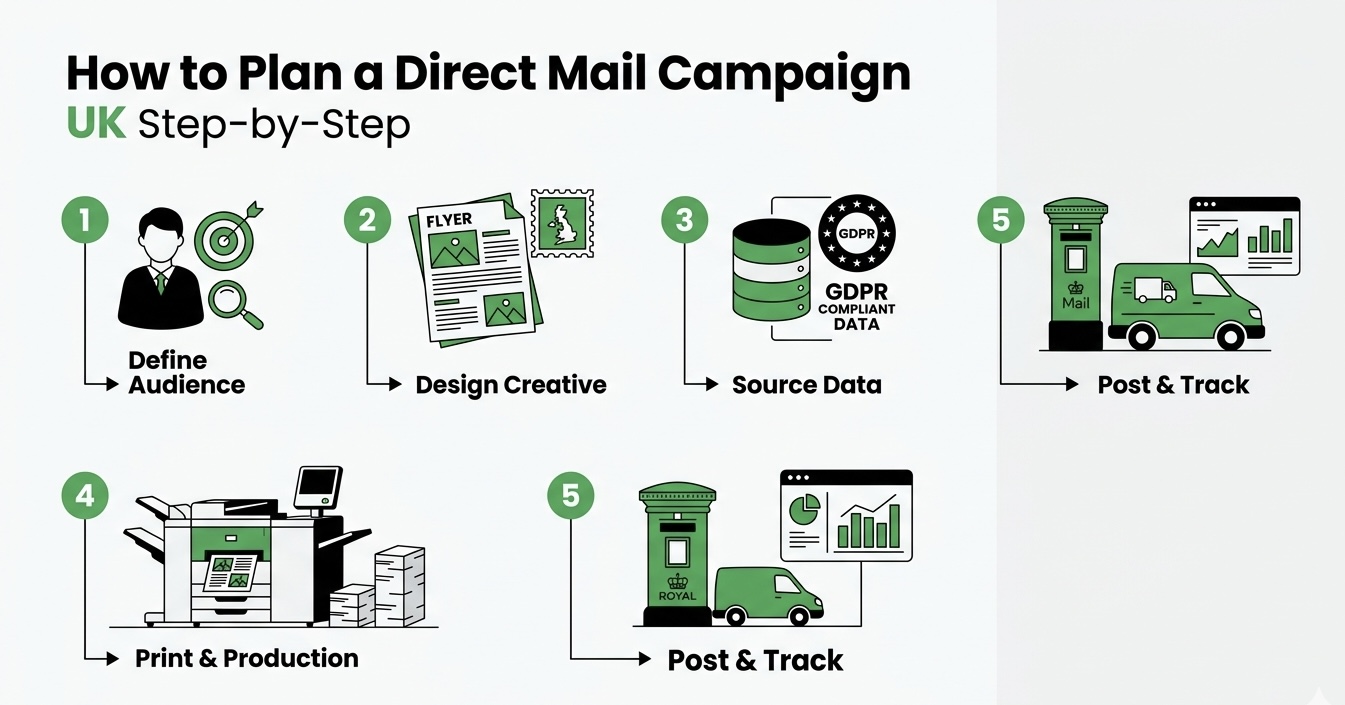
A successful direct mail campaign starts with clear goals, precise targeting, and a strong offer. For UK businesses, the best results usually come from a campaign that is planned around audience data, tracked carefully, and connected to a broader marketing strategy.
Introduction
Direct mail marketing remains one of the most effective ways to reach a specific audience in the UK. It gives businesses a physical, memorable way to connect with customers, especially when digital channels are crowded and competitive. But a direct mail campaign only works well when every stage is planned properly, from audience selection to delivery and follow-up.
This guide walks through how to plan a successful direct mail campaign step by step, with a structure that fits your UK pillar strategy and supports internal linking across
your content cluster. It also targets high-intent search terms like direct mail campaign UK, how to plan a direct mail campaign, direct mail strategy, and direct mail marketing steps.
What Is a Direct Mail Campaign?
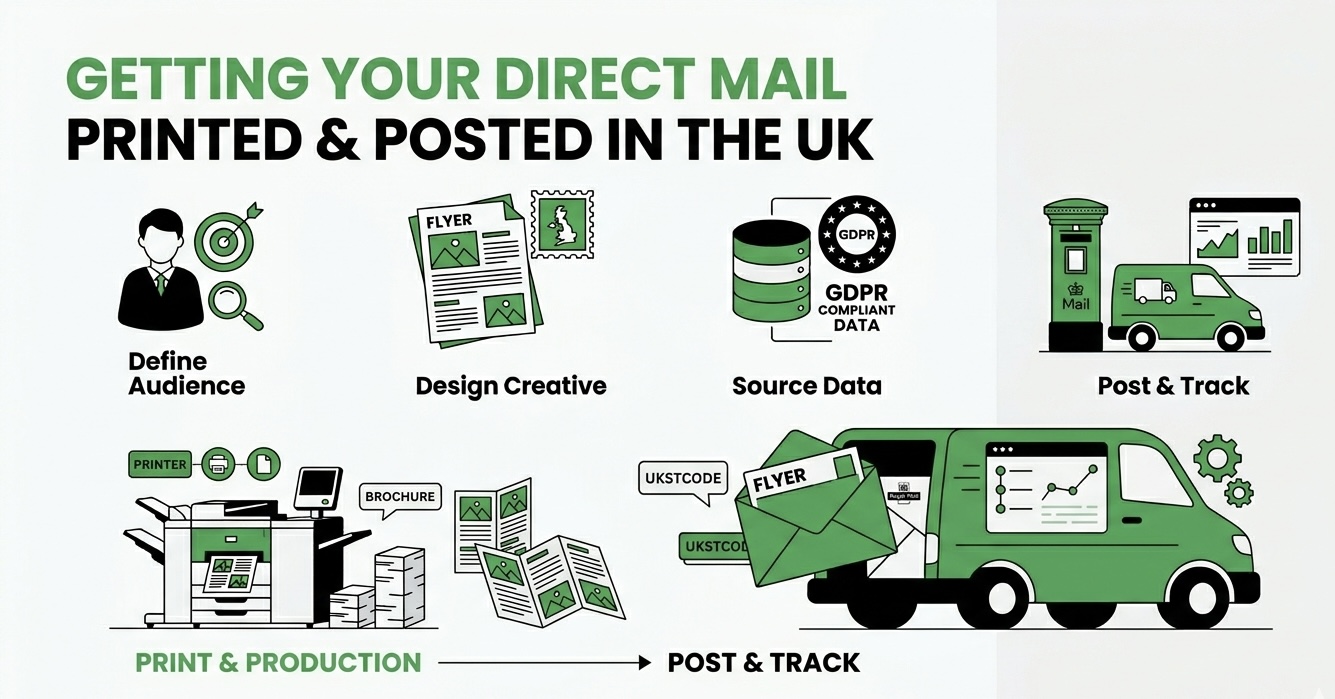
A direct mail campaign is a marketing activity where printed materials such as postcards, letters, flyers, or brochures are sent to a targeted audience through postal delivery. The aim is to encourage a specific action, such as visiting a website, booking a consultation, redeeming an offer, or making a purchase.
Direct mail is especially effective when the audience is carefully chosen, and the message is relevant.
Step 1: Set Clear Goals
Every successful campaign begins with a clear objective. Before designing anything, decide what you want the campaign to achieve.
Your goal might be to generate leads, increase footfall, promote a seasonal offer, drive website traffic, or re-engage existing customers. A clear goal helps shape the audience, offer, design, and call-to-action.
If the goal is vague, the campaign will also become vague. The more specific your objective, the easier it is to measure success later.
Step 2: Define Your Audience
Targeting is one of the most important parts of direct mail planning. The better your audience match, the more likely your campaign is to perform well.
UK businesses can segment audiences by postcode, geography, demographics, business type, buying behaviour, or previous customer history. This is especially useful for local service businesses, retail brands, and B2B campaigns where relevance matters.
This section should link naturally to How to Build a Targeted Mailing List for Direct Mail Campaigns, since audience quality has a direct impact on response rates and ROI.
Step 3: Build Your Mailing List
Once you know who you want to reach, you need a reliable mailing list. This list may come from your CRM, customer records, data providers, postcode-based targeting, or rental lists.
A strong mailing list should be accurate, up to date, and relevant to the campaign goal. Bad data can waste budget and reduce response rates, while a well-built list increases the chance of conversion.
For UK campaigns, mailing list quality is especially important because local targeting and address accuracy can make a major difference to performance.
Step 4: Choose the Right Format
The format of your mail piece should match your goal and budget. Different formats work better for different campaign types.
Postcards are simple, affordable, and easy to scan. Letters feel more personal and can be useful for high-value offers or B2B campaigns. Flyers and brochures provide more space for details, product information, or multiple offers.
If you are comparing formats, this is a strong opportunity to link to Flyer vs Postcard Marketing: Which One Works Better?.
Step 5: Create a Strong Offer
Your offer is the reason someone should respond. If the offer is weak, even a well-designed campaign may not generate strong results.
Good offers often include discounts, time-limited deals, free consultations, exclusive access, or useful incentives. The offer should be easy to understand and clearly relevant to the audience.
A strong offer does not always mean a deep discount. Sometimes the best offer is convenience, expertise, or a free next step.
Step 6: Write Clear Copy
The message on the mail piece should be direct, clear, and focused on the recipient’s benefit. Avoid cluttered copy and long explanations unless the format supports them, such as a letter or brochure.
A strong headline should quickly explain the value of the offer. Supporting copy should reinforce why the offer matters and what makes the business credible. Every sentence should help move the reader toward action.
This is also a useful place to link to your article on How to Design a High-Converting Direct Mail Postcard if the campaign uses postcard-style creative.
Step 7: Design for Attention
Good design helps a mail piece stand out and makes the message easier to absorb. The layout should be clean, the visuals should support the message, and the call-to-action should be easy to find.
Use enough white space to keep the piece readable. Highlight the offer clearly, and make sure the most important information can be understood at a glance.
The
best direct mail design is not the most complicated one. It is the one that communicates clearly and leads the reader to act.
Step 8: Add a Clear Call-to-Action
Every direct mail piece needs a strong call-to-action. The reader should immediately know what to do next.
Your CTA might ask them to visit your website, scan a QR code, call for a quote, book online, or use a code. The action should be simple, specific, and easy to complete.
If the CTA is weak or missing, the campaign loses momentum. Clear direction improves response and makes tracking much easier.
Step 9: Plan the Budget
Budgeting is a practical part of campaign success. You need to account for design, printing, list sourcing, postage, and tracking tools.
A campaign with a larger budget does not always perform better, but a poorly planned budget can quickly reduce ROI. Set the budget early so you can make informed decisions about format, list size, and distribution.
Budget planning also helps you decide whether to test a small batch first or run a larger campaign straight away.
Step 10: Print the Materials
Printing quality affects how your campaign is perceived. A poorly printed piece can reduce trust, while a clean and professional finish can improve credibility.
Consider paper quality, colour use, card stock, folding options, and finishing touches. The physical appearance of the mail piece should match the quality of the offer and the brand.
This is a natural place to link to Best Paper Types and Finishes for Direct Mail Campaigns if you have that cluster page.
Step 11: Distribute at the Right Time
Delivery timing can influence results. A campaign sent at the right time of year, week, or month may perform better than one sent randomly.
Think about seasonality, local events, pay cycles, and customer behaviour. For example, a retail campaign may work well before holidays, while a local service campaign may perform better at the start of a new season.
UK businesses often use Royal Mail for reliable distribution, especially when targeting specific geographic areas.
Step 12: Track Results
Tracking is essential if you want to understand what worked and what did not. Without tracking, you cannot confidently measure ROI or improve future campaigns.
Use QR codes, personalised URLs, unique discount codes, dedicated phone numbers, or campaign-specific landing pages. These tools make it easier to connect responses back to the original mail piece.
This is also the right place to link to Average Direct Mail Response Rates and What They Mean for Your Business.
Step 13: Test and Improve
The best campaigns are improved over time. Test different headlines, offers, audience segments, formats, and calls-to-action to see what works best.
Start with small changes and track the results carefully. Even a small lift in response rate can lead to a significant improvement in ROI across multiple campaigns.
Testing also helps you avoid repeating mistakes and gives you clearer insight into what your audience prefers.
Example Campaign
A local retail brand sends 2,000 postcards to households within a specific postcode area. The postcard includes a 10% discount, a QR code, and a clear deadline for the offer.
The campaign generates a 5% response rate, more store visits, and measurable sales. Because the audience was targeted and the offer was clear, the campaign delivered strong value.
Common Mistakes to Avoid
- Many campaigns underperform because of avoidable mistakes.
- Poor audience targeting.
- Weak or vague offers.
- Cluttered design.
- No tracking in place.
- Ignoring results and failing to improve.
Avoiding these issues can significantly improve the effectiveness of your direct mail campaigns.
How Direct Mail Fits Your Strategy
Direct mail works best as part of a wider marketing system. It can introduce the offer, while email and digital ads help follow up and reinforce the message.
This makes it a strong fit for multi-channel marketing, especially when you want to improve response and build customer trust across several touchpoints.
FAQs
How do I plan a direct mail campaign in the UK?
Start by setting a clear goal, defining your audience, building a mailing list, choosing the right format, creating a strong offer, and tracking the results.
What makes a direct mail campaign successful?
Success usually comes from good targeting, a strong offer, clear design, a simple call-to-action, and proper measurement.
What is the best format for direct mail?
The best format depends on your goal. Postcards are fast and affordable, letters are more personal, and brochures are better for detailed offers.
How can I improve direct mail ROI?
Improve targeting, strengthen your offer, test different versions, track responses, and use follow-up channels such as email or digital retargeting.
Should direct mail be used alone?
Usually not. Direct mail performs best when it is combined with email, online advertising, or other channels in a multi-channel strategy.
Final Thoughts
Planning a successful direct mail campaign takes more than choosing a postcard and sending it out. It requires clear goals, precise targeting, a strong offer, and ongoing optimisation.
For UK businesses, the best campaigns are built around data, relevance, and measurable action. When direct mail is planned properly and linked to the rest of your marketing strategy, it can drive strong engagement, better ROI, and long-term growth.
