
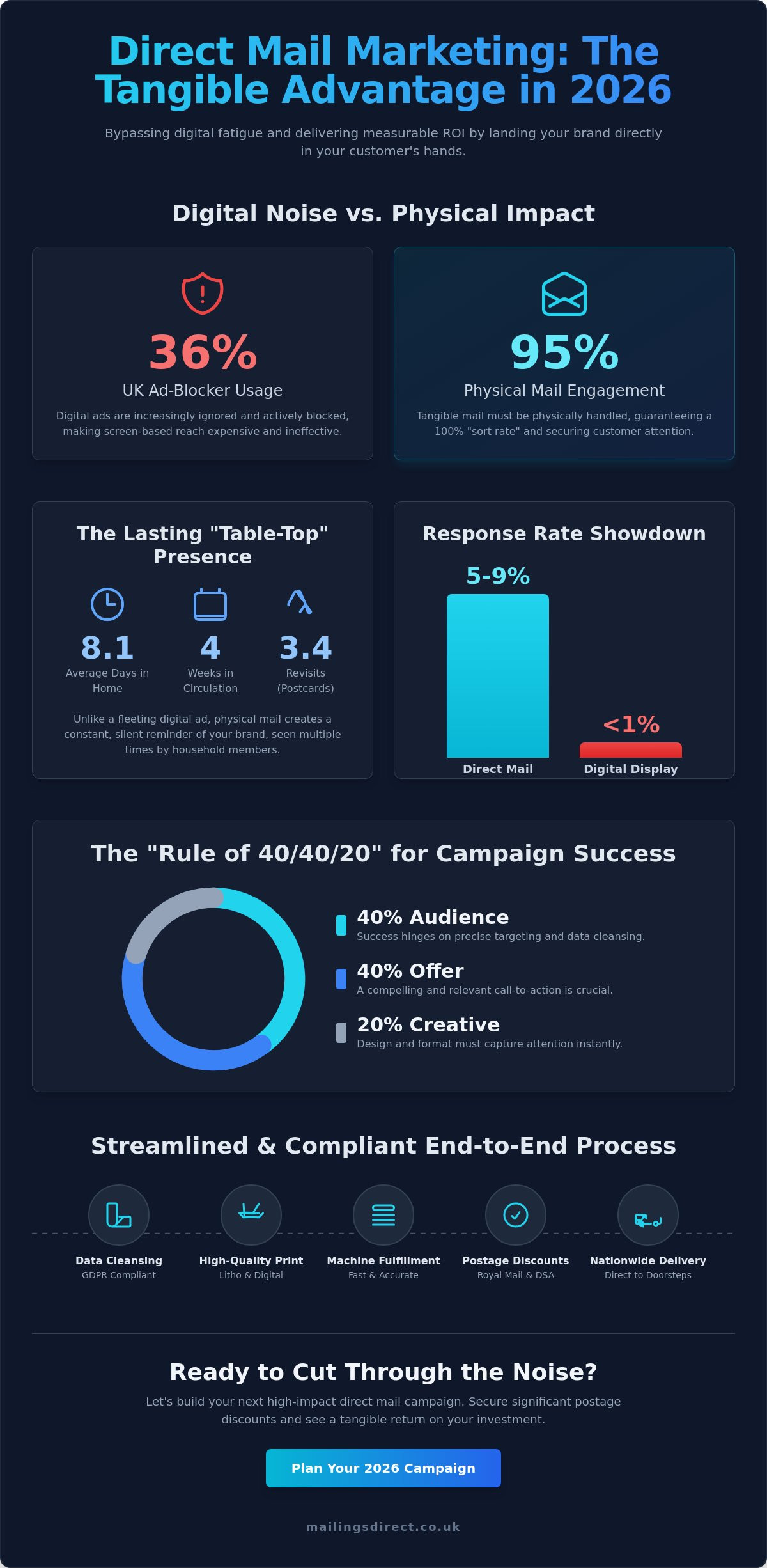
While digital ad-blocker usage in the UK reached 36% by the start of 2024, physical mail achieved a record 95% engagement rate according to JICMAIL research. This surge proves that direct mail marketing remains a vital tool for businesses looking to bypass digital fatigue and reach customers in a tangible way. You’ve likely noticed that reaching customers through a screen is becoming increasingly expensive and less effective. It’s frustrating to watch your marketing budget disappear into algorithms that your target audience actively tries to avoid.
We understand that the logistics of a physical campaign can feel daunting. This guide shows you how to break through the noise and ensure your brand lands directly in your customer’s hands while maintaining strict GDPR compliance. We provide a clear path to improve your ROI through precise data cleansing and strategic fulfillment. You’ll learn how to manage the end-to-end mailing process, from high-quality litho printing to securing significant postage discounts that help you avoid the high costs of standard Royal Mail first-class rates. We’ll outline a reliable, step-by-step strategy to ensure your 2026 campaigns are both seamless and cost-effective.
Key Takeaways
- Understand why the four-week lifespan of physical mail in UK households offers a tangible impact that digital advertising cannot replicate.
- Discover how to optimise your direct mail marketing by applying the “Rule of 40/40/20” to prioritise audience segmentation and offer relevance.
- Learn how to select machine-processable formats and professional fulfillment methods to significantly reduce production and postage costs.
- Identify the differences between Royal Mail and Downstream Access (DSA) providers to secure the most cost-effective delivery rates available.
- Explore the benefits of an end-to-end mailing house model to streamline complex logistics and ensure full GDPR compliance for your data.
What is Direct Mail Marketing in 2026?
Direct mail marketing is the strategic delivery of physical printed materials to a targeted audience at their home or business address. In 2026, this channel has evolved from simple mass-market leaflets into a sophisticated, data-driven tool. It provides a tangible touchpoint that cuts through the noise of an over-saturated digital environment. Brands now use physical mail to reclaim the attention that digital ads often lose in a split second. It’s a reliable method for reaching customers directly, bypassing the algorithms that govern online visibility.
Tangibility is the primary driver of success here. Data from JICMAIL reveals that physical mail remains in the UK home for an average of 8.1 days, with many pieces staying in circulation for up to four weeks. This longevity creates a “table-top” presence, where your brand message is seen multiple times by different household members. Unlike a fleeting social media post, a high-quality mailer sits in the physical space of your customer. It acts as a constant, silent reminder of your value proposition while providing a tactile experience that digital channels cannot match.
Response rates for direct mail marketing reflect its premium status. Targeted campaigns frequently achieve response rates between 5% and 9%, compared to the sub-1% often seen in digital display advertising. This efficiency makes it a reliable pillar for any multi-channel strategy. By handling the fulfillment and data cleansing in-house, businesses ensure their postage costs stay low while their impact remains high. This end-to-end approach removes the complexity from logistics and focuses on delivering measurable results.
The Core Benefits of Physical Marketing
Trust remains a cornerstone of the physical medium. UK consumers consistently rank addressed mail as more authoritative than digital pop-ups or unsolicited emails. By using specific paper weights and premium litho printing finishes, businesses build a sensory brand personality. We’ve seen a shift from generic door drops toward highly personalised, GDPR-compliant addressed mail. This precision ensures that your budget is spent on high-intent prospects rather than wasted on broad, irrelevant demographics. It’s about sending the right message to the right door at the right time.
Direct Mail vs. Digital Marketing
Digital fatigue has reached a breaking point for many UK consumers. While an email might be deleted without being opened, physical mail has a 100% “sort rate” because it must be physically handled to be organised. This physical interaction guarantees your message is seen. Modern campaigns bridge the gap between channels by using QR codes and personalised URLs (PURLs). These tools allow for seamless tracking and instant digital conversion from a physical prompt. While the initial cost-per-lead might be higher than a social media ad, the long-term value (LTV) of customers acquired through mail is often significantly higher due to the trust and brand recall established at the first touchpoint.
Essential Formats for Direct Mail Campaigns
Format selection is the intersection of brand goals and postal efficiency. Choosing the right physical medium dictates the ROI of your direct mail marketing before the first piece is even printed. It requires a balance between creative ambition and the rigid technical specifications of UK mailing houses. If a design exceeds standard dimensions by even a few millimetres, it can shift a campaign from Letter to Large Letter rates, increasing postage costs by up to 40%. Our role is to ensure your vision fits within the Royal Mail Mailmark specifications to secure the lowest possible rates.
Postcard Marketing: High Impact, Low Friction
Postcards are the fastest read format because they lack an outer envelope. They bypass the open or bin decision entirely. Successful designs follow the one-second rule: the headline and Call to Action (CTA) must be legible at a glance. For UK SMEs, this format offers the lowest entry price point for direct mail marketing. JICMAIL data from 2023 reveals that postcards are revisited 3.4 times on average, providing sustained brand exposure without the complexity of folding. We often recommend litho printing for these runs to ensure vibrant colours and a premium feel that stands out in a standard mail stack.
Letters and Envelopes: The Authority of Direct Mail
A sealed envelope carries psychological weight. It suggests privacy and importance, making it the preferred choice for financial services or high-value B2B offers. Personalised addressing increases open rates significantly compared to generic alternatives. We suggest using window envelopes for high-volume campaigns to ensure address accuracy through automated machine enclosing. Direct-printed envelopes offer a more bespoke feel for low-volume, high-value outreach. Our team handles the direct mail fulfillment process to ensure every insert is matched correctly to the right recipient, maintaining the integrity of your data.
Leaflets, Brochures, and Catalogues
Leaflets provide a cost-effective way to achieve broad-reach brand awareness in specific UK postcodes. While digital fatigue grows, the physical catalogue has seen a resurgence as a high-end coffee table item. Research indicates that 45% of consumers keep catalogues for over a week. For multi-page brochures, polywrapping provides essential protection during transit while allowing the cover design to remain visible. This format allows for deep storytelling that digital ads cannot replicate. We manage the entire process, from data cleansing to the final drop, ensuring your multi-page documents arrive in pristine condition.
The Logistics of Direct Mail: From Data to Delivery
Successful direct mail marketing relies on three core pillars: data, print, and fulfilment. Managing these elements independently often leads to fragmented campaigns, missed deadlines, and inflated costs. A professional mailing house provides a unified workflow that removes the logistical burden from your marketing team. We handle the technical heavy lifting, transforming raw data into physical mail pieces delivered directly to your customers’ doors.
The most common objection we hear from UK business owners is that the process feels too complicated to manage. This concern disappears when you adopt an end-to-end service model. Instead of coordinating with multiple vendors, you work with one partner who oversees the entire lifecycle of the campaign. This approach is significantly more efficient, ensuring that production schedules align perfectly and maximum postage discounts are secured. It provides a safe pair of hands for your brand, replacing complexity with a streamlined, industrial-scale operation.
Data Cleansing and GDPR Compliance
Dirty data remains the largest hidden cost in the industry. Sending mail to incorrect addresses or deceased individuals wastes budget and damages brand perception. In 2026, maintaining a GDPR-ready list is a fundamental requirement for addressed mail. Our process includes:
- MPS Screening: We check lists against the Mail Preference Service to respect consumer privacy and maintain legal compliance.
- Gone-away Suppression: We identify and remove records for individuals who have moved, saving you the cost of undeliverable items.
- PAF Validation: We verify every address against the Royal Mail Postcode Address File to ensure delivery accuracy.
Cleansing your data can reduce postage waste by up to 15 percent, making it an essential step for any cost-effective campaign.
Printing and Fulfilment Excellence
The choice between litho and digital printing depends on your volume and personalisation needs. Litho printing remains the standard for high-volume runs, offering exceptional cost-efficiency for large-scale campaigns. Digital printing provides the flexibility for variable data, allowing you to customise every aspect of the mailer for the recipient. For assembly, machine enclosing offers the speed and accuracy required for bulk mail. However, we provide hand fulfilment for bespoke, high-value marketing packs where a personal touch or complex assembly is required. This technical precision ensures your direct mail marketing arrives in pristine condition, ready to engage your audience and drive results.
Strategies for Maximising Campaign Response Rates
Success in direct mail marketing hinges on precision rather than guesswork. You must define your audience with clinical accuracy before any ink hits the paper. Effective segmentation involves categorising your database by purchase frequency, geographic location, or demographic profile. This ensures your message reaches the individuals most likely to convert. We handle the technical aspects of data cleansing to remove duplicates and incorrect addresses, ensuring your budget isn’t wasted on undeliverable mail.
We apply the ‘Rule of 40/40/20’ to every project we manage. This industry standard dictates that 40% of your campaign’s success relies on the quality of your mailing list, 40% on the strength of your offer, and only 20% on the creative design. While aesthetics matter, a visually stunning brochure sent to the wrong person with a weak incentive will fail. It’s a pragmatic framework that keeps the focus on what actually generates revenue. Your offer needs to be tangible and valuable, such as a significant discount or an exclusive invitation.
Your Call to Action (CTA) must be singular and urgent. Avoid cluttering the page with multiple requests; instead, tell the recipient exactly what to do next. Whether it’s “Claim your £20 voucher by Friday” or “Visit your local branch for a free consultation”, clarity drives response. We recommend A/B testing different headlines or offers on a small sample size before committing to a full print run. This methodical approach reduces risk and increases ROI by identifying the most effective messaging early in the process.
Personalization and Variable Data Printing
Generic greetings like “Dear Customer” are relics of the past. Modern variable data printing (VDP) allows us to customise every element of your mailer in a single production run. We can pull specific purchase history or local branch details from your database to create a bespoke experience for every recipient. Data from JICMAIL indicates that personalised mail is often revisited 4.5 times on average. Small touches, such as printing the recipient’s name on the outer envelope, significantly improve initial engagement rates and build immediate trust.
Integrating Direct Mail into the Marketing Mix
Physical mail works best when it supports your digital channels. Programmatic mail allows you to send a physical postcard to a customer who abandoned a digital shopping cart within 24 to 48 hours. This tactile reminder cuts through digital noise where emails are often ignored. We follow the “Seven Touches” rule, acknowledging that prospects need multiple interactions before buying. You can track these offline conversions easily by using unique coupon codes, QR codes, or dedicated landing pages. This provides clear data on which direct mail marketing pieces generated the most revenue.
Learn how our end-to-end mailing services can streamline your next campaign and improve your response rates.
Navigating UK Postage Costs and Mailing Houses
Postage often represents the largest single expense in any direct mail marketing campaign. While Royal Mail maintains the “final mile” delivery to 32 million UK addresses, businesses shouldn’t pay standard retail rates. Professional mailing houses act as high-volume intermediaries. They use wholesale accounts to secure pricing that simply isn’t available at a Post Office counter. This approach moves your project from a consumer transaction to an industrial process, where efficiency drives down the cost per unit.
Technology plays a vital role in these savings. Mailmark technology is now the industry standard for 2026. It uses a 2D barcode on every envelope, allowing Royal Mail’s automated systems to track and sort mail with 99.9% accuracy. Because this reduces manual handling, carriers offer lower rates to those who use it. A professional partner ensures your artwork and address placement meet these strict technical specifications, preventing expensive surcharges or delivery delays.
How to Access Bulk Postage Discounts
Mailsort is the primary engine for reducing costs. By pre-sorting your mail into specific postcode bundles before it leaves the warehouse, you do the heavy lifting for the carrier. This earns your business a substantial discount. Downstream Access (DSA) takes this further. Providers like Whistl or Citipost collect your mail from the mailing house and transport it to regional distribution centres, only handing it to Royal Mail for the final delivery.
Looking ahead to the remainder of 2026, postage rates are expected to remain sensitive to fuel and labour costs. Smart businesses are hedging against price increases by booking high-volume slots three to six months in advance. This locks in current tariffs and ensures capacity during peak seasons like the Q4 “Golden Quarter”.
Selecting a UK Direct Mail Company
Choosing a partner requires more than just comparing quotes. You need a provider with the capacity to handle your peak volumes and the data security certifications, such as ISO 27001, to protect your customer database. An end-to-end service handles everything from litho printing to final fulfillment, acting as a “safe pair of hands” that removes the stress of managing multiple vendors.
For a detailed checklist on vetting potential partners, read our guide on Choosing the Best Direct Mail Companies: A 2026 Buyer’s Guide. You can also explore our Professional Direct Mail Services to see how a full-service approach streamlines your direct mail marketing operations. Working with a specialist ensures your campaign is compliant, cost-effective, and delivered on time.
Secure Your Competitive Edge in 2026
Success in the coming year requires a move away from digital saturation and a return to high-impact, physical touchpoints. Direct mail marketing in 2026 isn’t just about sending letters; it’s about precision logistics and data-driven targeting. By prioritising GDPR-compliant data cleansing as standard, you protect your brand’s reputation and ensure every piece of mail reaches a valid recipient. Navigating the UK postal landscape also demands a strategic approach to costs. We help you secure significant savings on UK postage by leveraging Downstream Access (DSA) and Mailsort, ensuring your budget works harder across every campaign.
Mailings Direct offers a seamless, end-to-end fulfilment service that manages the entire process from data to delivery. We act as your authoritative partner, handling the technical complexities of litho printing and mail sorting so you don’t have to worry about the details. Our one-stop shop approach provides the reliability and precision needed to execute large-scale campaigns without the stress. It’s time to move beyond the inbox and put your brand directly into your customers’ hands.
Get a bespoke quote for your 2026 direct mail campaign today
We’re ready to help you deliver a campaign that drives measurable results and strengthens your market position.
Frequently Asked Questions
Is direct mail marketing still effective in 2026?
Direct mail marketing remains highly effective in 2026 because it bypasses digital fatigue. JICMAIL data shows that physical mail stays in a household for an average of 8.2 days, creating multiple brand impressions. While many digital ads are ignored, 94% of mail is engaged with by recipients. It provides a tangible connection that digital channels can’t match, making it a reliable pillar for modern campaigns.
How much does a direct mail campaign cost in the UK?
Campaign costs depend on your volume, weight, and chosen format. Royal Mail wholesale rates provide significant discounts for bulk mailings exceeding 4,000 items. You’ll need to budget for data procurement, professional design, high-quality printing, and postage. Using a professional mailing house helps you access lower postage tiers that aren’t available to individual businesses, ensuring your project stays cost-effective.
Is direct mail GDPR compliant for UK businesses?
Direct mail is fully GDPR compliant when you follow the correct legal procedures. Unlike email marketing, which requires explicit opt-in under PECR, physical mail can often be sent using “Legitimate Interests” as a legal basis. You must still conduct a Legitimate Interests Assessment and screen your data against the Mailing Preference Service. It’s a dependable way to reach prospects without needing prior digital consent.
What is the average response rate for direct mail?
The average response rate for direct mail typically ranges between 5% and 9% for existing customer lists. For prospect lists, the Data & Marketing Association reports rates around 2.9%. These figures are significantly higher than the 0.1% average click-through rate seen in most display advertising. Your specific results will depend on the relevance of your offer and the quality of your data cleansing.
What is a mailing house and why do I need one?
A mailing house is a specialist facility that handles the printing, folding, enclosing, and distribution of your marketing materials. You need one to access industrial-scale litho printing and automated fulfillment processes that reduce manual labor costs. We manage the entire logistics chain and ensure your campaign meets strict Royal Mail specifications. This end-to-end service secures the lowest possible postage rates for your business.
How long does it take to print and post a direct mail campaign?
Most standard campaigns take between 5 and 10 working days from final artwork approval to postal handover. Complex projects involving bespoke die-cutting or multi-item matching might require additional time for precision fulfillment. Once we hand your mail to the carrier, delivery speed depends on the service level you’ve chosen. We provide clear, methodical timelines at the start of every project to ensure punctuality.
Can I send direct mail without a customer database?
You can launch a campaign without your own database by using cold list rental or door drop services. We help you source GDPR-compliant prospect data based on specific demographics or postcode sectors. Partially Addressed Mail is another effective option that targets households without using personal names. This allows you to reach 100% of a target area while maintaining strict privacy standards and professional integrity.
How do I track the ROI of my physical mail campaign?
Track your ROI by including unique identifiers like QR codes, personalized URLs, or dedicated phone numbers on your mailers. These tools allow you to link physical mail engagement directly to digital conversions in your analytics dashboard. By measuring the redemption rate of specific offer codes, you can calculate the exact cost per acquisition. This data-driven approach ensures your direct mail marketing remains accountable and transparent.