
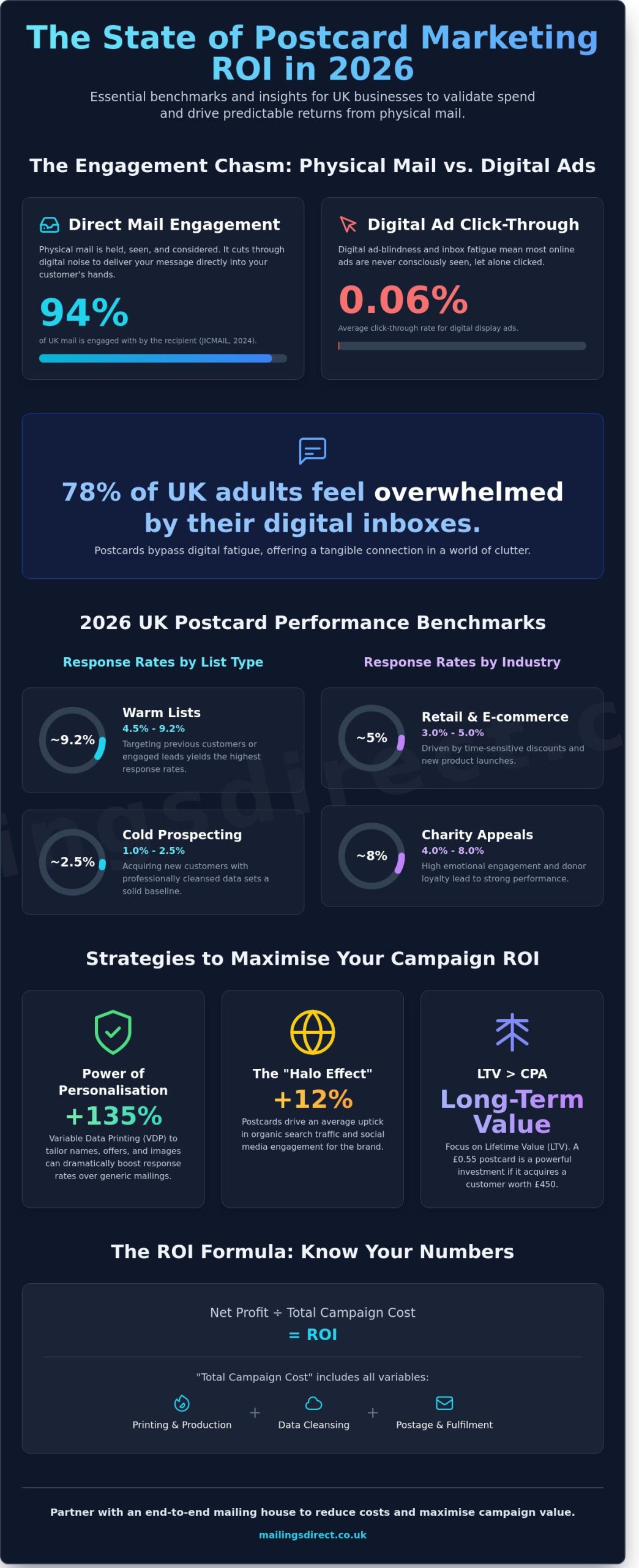
While digital display click-through rates have plummeted to a mere 0.06%, recent 2024 JICMAIL data reveals that 94% of UK mail is engaged with by the recipient. You’ve likely noticed that the rising cost of Royal Mail postage and the increasing noise of the digital landscape make it harder than ever to secure a predictable return on investment. It’s often difficult to justify marketing spend when stakeholders demand proof of offline conversions that traditional tracking sometimes misses.
This guide delivers the essential postcard marketing roi benchmarks for 2026, providing the concrete data you need to validate your spend and set realistic KPIs for your upcoming Q3 and Q4 campaigns. We’ll examine current response rates, identify methods to lower your cost per acquisition through professional data cleansing, and show you how a bespoke fulfillment strategy ensures your physical mail works as hard as your digital channels. We provide the clarity you need to transform complex logistics into a reliable, high-performance revenue stream.
Key Takeaways
- Understand why tangible mail is outperforming digital channels in 2026 by cutting through ad-blindness and achieving greater longevity in UK households.
- Access the latest postcard marketing roi benchmarks for the UK market, featuring specific performance data for the retail, charity, and B2B sectors.
- Compare cost-per-acquisition metrics between digital ads and physical mail to identify which channel provides the most cost-effective route to new customers.
- Master the standard ROI calculation for direct mail, including how to account for “hidden” costs like data cleansing and postage to protect your margins.
- Learn how partnering with an end-to-end mailing house reduces fulfilment costs and streamlines the printing process to maximise your campaign value.
Understanding Postcard Marketing ROI in the 2026 UK Landscape
Calculating Return on Investment (ROI) for physical mail requires a departure from digital-only thinking. In the 2026 UK market, ROI is the net profit generated from a campaign divided by the total costs of production, data cleansing, and postage. It’s a clear-cut metric that demonstrates the efficiency of your marketing spend. While digital metrics often focus on fleeting clicks, postcard marketing roi benchmarks provide a more stable picture of long-term business growth. We focus on providing a “safe pair of hands” for these calculations, ensuring every penny spent on litho printing and fulfillment is accounted for.
The resurgence of tangible mail in 2026 stems from a widespread rejection of digital clutter. Recent consumer surveys indicate that 78% of UK adults feel overwhelmed by their digital inboxes. Physical postcards bypass this fatigue. They offer a tactile advantage that triggers higher brand recall than a standard email. When a customer holds a well-designed postcard, they engage multiple senses, which creates a stronger cognitive link to your brand. This physical connection is a primary driver of the “keep-ability” factor that digital ads simply cannot replicate. It’s a bespoke approach that turns a simple message into a professional brand statement.
The 2026 Shift: Why Postcards Outperform Digital
Digital ad-blindness reached record levels this year. With the “Inbox Zero” movement gaining traction among UK professionals, marketing emails are frequently deleted without a single glance. Data from 2025 confirms that the average UK household receives only 1.2 pieces of direct mail daily. This lack of competition in the physical letterbox makes postcards the most scannable and effective format available. Unlike letters, postcards require no opening, ensuring your message is seen the moment it’s picked up. Understanding the history of direct mail marketing reveals that this simplicity has always been its greatest asset for driving immediate action and maintaining high postcard marketing roi benchmarks.
Key Metrics to Track Beyond the Initial Sale
Successful campaigns look past the initial transaction. We advise clients to balance their Customer Acquisition Cost (CPA) against the projected Lifetime Value (LTV) of the lead. A postcard might cost £0.55 to deliver, but if it acquires a client worth £450 over two years, the ROI is exceptional. You should also monitor the “Halo Effect,” where physical mail drives a 12% uptick in organic search traffic and social media engagement. Tracking these multi-channel interactions provides a complete view of campaign performance. High-quality cardstock and precision fulfillment improve brand sentiment, turning a one-off mailer into a reliable tool for long-term customer retention.
Current Postcard Marketing ROI Benchmarks and Response Rates
Establishing accurate postcard marketing roi benchmarks requires a clear distinction between cold and warm data sets. In the 2026 UK market, warm mailing lists consisting of previous customers typically achieve response rates between 4.5% and 9.2%. Cold prospecting campaigns naturally see lower engagement, often landing between 1% and 2.5% depending on the quality of the data cleansing. These figures are supported by the latest advertising spend figures, which highlight a renewed confidence in physical mail as digital channels become increasingly saturated and expensive.
Personalisation remains the most effective lever for increasing these numbers. Utilising Variable Data Printing (VDP) to tailor images, names, or specific offers to recipients can increase response rates by up to 135% compared to generic postcards. For a campaign to be successful, you must establish a break-even target before the first stamp is applied. If your total campaign cost is £2,500 and your average profit per conversion is £100, you need 25 responses to cover costs. Knowing this specific number ensures your strategy is grounded in financial reality rather than guesswork.
2026 UK Performance Benchmarks by Industry
Retail and e-commerce brands often lead the way with high-volume mailings. These sectors expect response rates of 3% to 5%, driven by time-sensitive discounts or seasonal product launches. Charity appeals consistently outperform other sectors due to high emotional engagement and long-term donor loyalty. We see response rates for donor renewals reaching 4% to 8% when the creative execution is strong. Professional services, such as legal or financial firms, target lower volumes but higher-value conversions. While a 1.2% response rate might seem modest, the high lifetime value of a single client often results in a superior total ROI.
The Role of Frequency in Benchmarking
A single postcard drop rarely achieves peak performance. The “Power of Three” rule suggests that recipients need multiple physical touchpoints to move from awareness to action. Drip campaigns, where mailings are staggered over several weeks, typically see a 22% higher cumulative ROI than a single burst campaign. Seasonal shifts also play a major role in the UK market. Response rates for retail often climb by 18% during the Christmas lead-up and the spring bank holiday periods. To maximise your budget during these peaks, you can optimise your postage costs with our expert team to ensure your multi-drop strategy remains cost-effective and sustainable.
Postcards vs Digital: Why Physical Mail Wins in 2026
Digital saturation reached a breaking point in early 2026. UK consumers now ignore 85% of display ads and delete marketing emails within two seconds of opening them. Physical mail cuts through this noise because it requires tactile interaction. It can’t be closed with an “X” or filtered into a junk folder by an algorithm. For businesses seeking reliable growth, postcards offer a tangible presence that digital channels simply cannot replicate.
The CPA Showdown
Google Ads CPCs for competitive UK sectors like home services or finance now frequently exceed £4.50. These rising costs erode margins and make digital scaling difficult for many firms. Postcard campaigns provide a more stable alternative. By using Mailsort and professional fulfillment services, we help businesses reduce postage costs by up to 32%. This makes the total cost-per-acquisition often lower than digital channels where bidding wars and ad-fraud are constant risks. When assessing postcard marketing roi benchmarks, the ability to target high-intent households using data cleansing ensures your budget isn’t wasted on undeliverable addresses or outdated records.
Attention Span and Engagement Metrics
Direct mail commands a level of attention that pixels cannot match. JICMAIL data confirms that the average piece of direct mail stays in a UK home for 8.2 days. It often sits on a kitchen counter or mantelpiece, where it is viewed by multiple household members. This leads to the “132-second rule,” which represents the average time a person spends engaging with physical mail over its lifespan. In contrast, a social media ad is lucky to receive two seconds of focus. Litho printing ensures your brand looks professional and high-quality, creating a psychological impact that builds lasting brand recall.
Trust remains a significant differentiator. 71% of UK consumers find physical mail more “official” and secure than digital alternatives, which are often associated with phishing and data privacy concerns. This sentiment is a primary driver behind The Direct Mail Revival, which highlights that physical campaigns can achieve a strong ROI of 43%. Our one-stop shop approach allows you to capitalise on this trust by delivering professional, GDPR-compliant mailers directly to your target audience.
Modern postcards bridge the gap through “Phygital” integration. Adding a bespoke QR code allows for seamless tracking and instant conversion on a mobile device. Campaigns using this hybrid approach see a 20% increase in response rates compared to standalone physical mail. This data-driven strategy solidifies postcard marketing roi benchmarks as a reliable, essential metric for any 2026 marketing plan. We handle the entire process from design advice to final delivery, ensuring your campaign is both cost-effective and high-performing.
The ROI Formula: Calculating and Maximising Your Campaign Value
Calculating the true performance of your mailer requires more than a simple tally of sales. The standard ROI formula is (Revenue – Cost) / Cost. While this provides a baseline percentage, the accuracy depends entirely on the data you feed into it. To align with 2026 postcard marketing roi benchmarks, you must account for every penny spent across the end-to-end process. This includes data procurement, creative design, litho printing, and final postage. Ignoring these “hidden” costs leads to an inflated sense of success that doesn’t reflect your actual bank balance.
Data cleansing is the most effective way to protect your margins before a single card is printed. Removing “gone-away” records or deceased contacts prevents you from paying for mail that cannot be delivered. Current industry data suggests that 10% of B2C data decays every year. By auditing your lists, you instantly reduce waste and improve your response rates. You can also lower your entry costs by leveraging Royal Mail incentives. Schemes such as the “Testing and Learning” or “First Time User” programmes provide postage discounts of up to 15%, making high-volume campaigns significantly more accessible.
Step-by-Step: Calculating Your True ROI
Start by gathering every production cost. This covers everything from the initial data purchase to hand-fulfilment for bespoke items. Once the campaign is live, use unique offer codes or dedicated URLs to attribute revenue accurately. Don’t stop at the initial sale. High-performing campaigns factor in the long-tail revenue. If a postcard acquires a customer with a 24-month lifetime value of £500, that initial £0.50 investment looks much stronger than if you only count the first £30 transaction.
Three Ways to Maximise Your ROI Today
- Data Hygiene: Removing just 10% of “dirty data” from a 50,000-unit mailing saves thousands in print and postage. It ensures your message reaches active, valid addresses.
- A/B Testing: Never send a single version. Test two different headlines or offers on small batches. Scale the winner to the rest of your list to ensure the highest possible conversion rate.
- Postage Optimisation: Use Mailsort and Downstream Access (DSA) to secure the deepest discounts. These technical sorting processes allow us to bypass certain Royal Mail stages, passing the savings directly to you.
We provide the technical expertise and high-capacity printing needed to drive these results. If you want to improve your margins, we can help you optimise your postage costs and streamline your entire fulfilment process.
Partnering with a UK Mailing House to Exceed ROI Benchmarks
Achieving high postcard marketing roi benchmarks requires more than just a creative design; it demands a rigorous focus on the “cost” side of the ROI equation. By partnering with a professional mailing house, you eliminate the inefficiencies of fragmented supply chains. We handle everything from high-quality litho printing to complex postage management under one roof. This integrated approach typically reduces production overheads by 15% to 25% compared to managing separate vendors, directly improving your bottom line.
Maintaining GDPR compliance acts as a critical ROI protector for any UK business. A single data breach or a non-compliant mailing can result in Information Commissioner’s Office (ICO) fines reaching up to £17.5 million or 4% of annual turnover. We provide robust data cleansing services that remove duplicates and “gone-aways” from your lists. This ensures you don’t waste budget on undeliverable mail, which keeps your response rates high and protects your professional reputation.
In 2024, a regional UK home improvement firm utilised our end-to-end fulfilment services for a 15,000-piece targeted drop. By using our bulk postage rates and data suppression tools, they reduced their total campaign spend by 19%. This efficiency allowed the campaign to generate £52,000 in attributed revenue from a £16,500 investment, resulting in a 215% ROI. This demonstrates how technical precision translates into financial performance.
Why a “One-Stop Shop” Matters
Efficiency is the cornerstone of a successful campaign. Our end-to-end service reduces lead times by up to 72 hours, allowing you to hit market windows while consumer demand is at its peak. Combining full-colour printing with direct fulfilment means your postcards move from the press to the postal system without logistical delays. This level of reliability ensures your campaign lands on the mat exactly when planned, providing a stable foundation to meet your postcard marketing roi benchmarks.
- Reduced Lead Times: Swift transition from design approval to the Royal Mail network.
- Cost-Efficiency: Significant savings by combining print and postage procurement.
- Precision: Automated addressing and fulfilment systems eliminate manual errors.
Getting Started with Your ROI-Driven Campaign
To hit your targets in 2026, you need a strategy backed by technical expertise and transparent costs. We start by consulting on your data quality to ensure every penny of your budget is targeted effectively. We then provide a clear, bespoke quote based on your specific volume and postage requirements, removing any guesswork from your marketing spend.
Future-Proof Your UK Marketing Strategy
The 2026 UK landscape proves that physical touchpoints consistently outperform digital clutter. Recent industry data shows direct mail achieves a 3.1% average response rate compared to just 0.1% for standard email campaigns. By aligning your strategy with current postcard marketing roi benchmarks, you’ll position your brand to achieve an average return of £12 for every £1 invested. Success in this competitive market relies on precise data cleansing and professional fulfilment to ensure your message reaches the right door at the right time.
Mailings Direct removes the stress from complex logistics by providing a reliable, end-to-end solution for your business. We leverage over 20 years of UK mailing expertise to handle everything from litho printing to GDPR-compliant data management. Our team delivers cost-effective results that help you bypass the digital noise and create tangible connections with your audience. It’s time to secure your campaign’s success with a partner you can trust.
Get a Professional Postcard Marketing Quote Today
Your next high-impact campaign is ready to launch, and we’re here to help you deliver it perfectly.
Frequently Asked Questions
What is the average ROI for postcard marketing in the UK in 2026?
The projected average ROI for postcard marketing in the UK for 2026 is £3.22 for every £1 spent. This performance level is driven by high household engagement, as JICMAIL data shows physical mail is interacted with 3.8 times on average. We help you reach these postcard marketing roi benchmarks by using precision targeting and high-quality litho printing that commands attention in a crowded digital world.
How do I track the ROI of a physical postcard campaign?
You track the ROI of a physical postcard campaign by using trackable triggers like QR codes, unique discount codes, or dedicated phone numbers. These methods allow you to attribute every sale or lead to a specific mailing batch. We recommend using personalised URLs (PURLs) to monitor individual recipient behaviour. This data provides a clear picture of your campaign’s success and helps you refine your strategy for future mailings.
Is postcard marketing more expensive than email marketing?
Postcard marketing has a higher initial unit cost than email, but it often delivers a lower cost-per-acquisition due to higher engagement. While an email might cost less than a penny, it faces a 20% average open rate and frequent spam filters. In contrast, postcards achieve a 90% open rate and stay in the home for 7.1 days. This tangible presence creates more opportunities for conversion, making it a highly cost-effective choice.
What is a “good” response rate for a cold mailing list in the UK?
A good response rate for a cold mailing list in the UK typically ranges from 1% to 2% for direct sales. If your goal is lead generation, you might see figures climb to 5% depending on the strength of your offer. Your ability to hit these postcard marketing roi benchmarks depends heavily on the quality of your data. Using a bespoke, GDPR-compliant list ensures your message reaches people who actually need your services.
How can data cleansing improve my postcard marketing ROI?
Data cleansing improves your ROI by removing “goneaways” and deceased records that could account for 15% of your database every year. You don’t want to pay for printing and postage for mail that will never be delivered. We handle the technical process of cleaning your lists against the Royal Mail’s Postcode Address File. This ensures your budget is spent only on reachable prospects, which immediately increases your campaign’s efficiency.
Do QR codes on postcards actually improve conversion rates?
QR codes on postcards improve conversion rates by an average of 30% compared to mailings without them. They provide a seamless bridge between a physical piece of card and your digital checkout page. Recipient friction is reduced because they don’t have to type in a long website address. This simple addition makes your campaign interactive and provides you with instant, real-time data on how your audience is responding.
What are the main costs involved in a postcard marketing campaign?
The main costs include data acquisition, graphic design, printing, and postage. Postage is usually the largest expenditure, often making up 50% or more of your total campaign budget. We provide a one-stop shop service that handles all these elements under one roof to keep prices low. By managing the fulfillment process internally, we remove the stress of coordinating multiple suppliers and ensure your costs remain predictable.
How does Mailsort help reduce my overall campaign costs?
Mailsort reduces your costs by pre-sorting your postcards into specific delivery areas before they are handed over to the Royal Mail. Because you’ve done the heavy lifting of sorting the mail, the carrier offers a significant discount on postage rates. You can save between 15% and 30% on your total postage bill using this method. It’s a reliable way to make large-scale campaigns more affordable while maintaining a professional delivery schedule.