
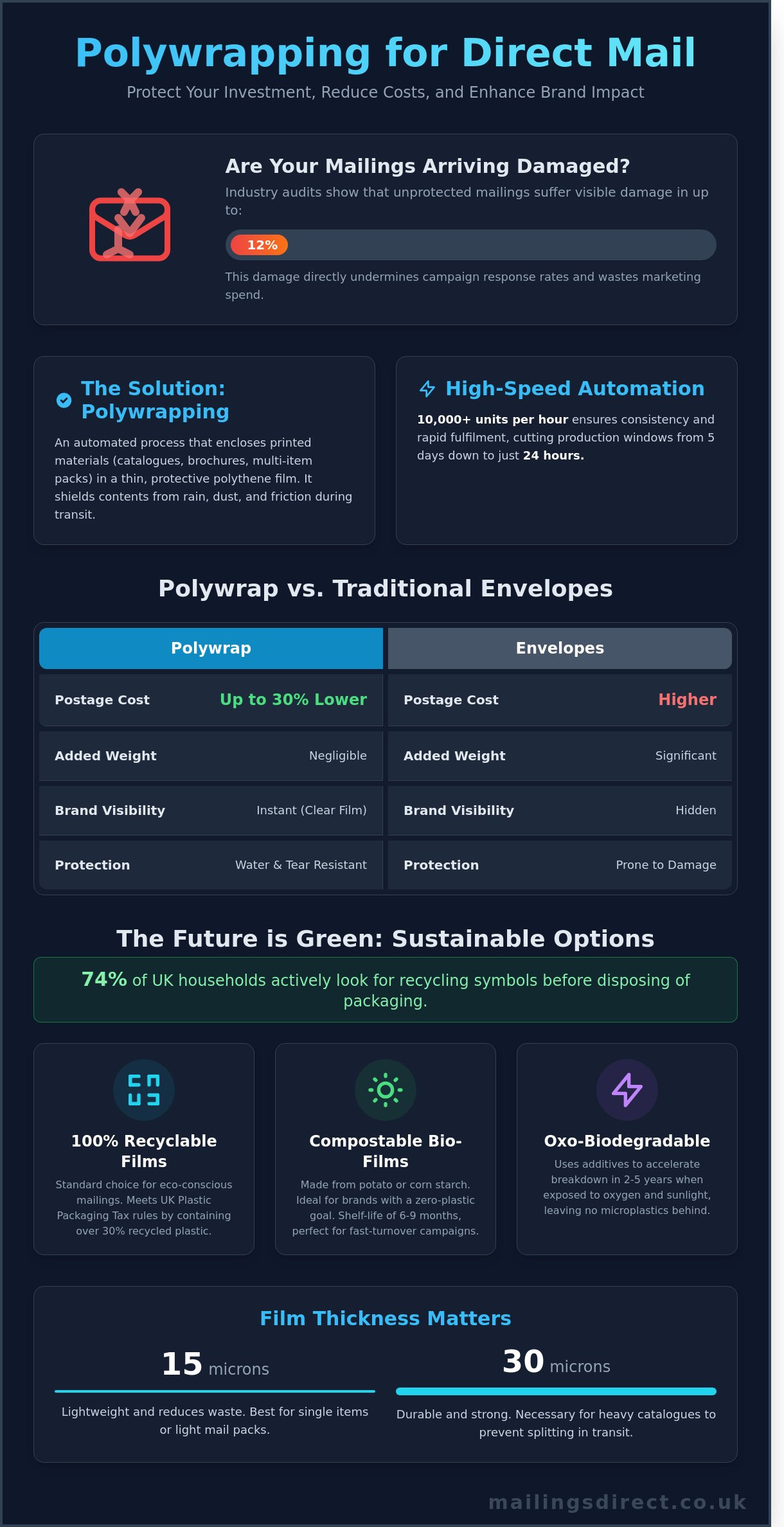
How much of your marketing budget is effectively being shredded in the Royal Mail sorting system before it reaches a customer? 2023 industry audits suggest that unprotected mailings suffer visible damage in up to 12% of cases, which directly undermines your campaign’s response rates. You know that for high-volume UK campaigns, maintaining the integrity of your catalogues and brochures is vital. Implementing a professional polywrapping strategy ensures your materials remain pristine while moving through the postal network at maximum efficiency.
You likely agree that balancing rising postage costs with the need for high-impact presentation is a constant challenge for modern marketing managers. This guide shows you how to protect your investment, reduce per-unit mailing costs by as much as 30% through strategic carrier selection, and enhance brand visibility. We will examine everything from the mechanics of high-speed fulfilment to GDPR-compliant data handling and the latest sustainable film options available for British businesses.
Key Takeaways
- Understand why polywrapping is the preferred automated solution for protecting and presenting high-volume catalogues, brochures, and multi-item packs.
- Explore the shift towards sustainable material options, including 100% recyclable films, to ensure your 2026 mailings meet modern environmental standards.
- Compare the weight and visibility benefits of polywrap against traditional envelopes to significantly reduce your postage costs and enhance brand impact.
- Learn how to correctly prepare carrier sheets and artwork to ensure your campaign meets all Royal Mail barcode requirements for seamless delivery.
- Discover how an end-to-end fulfilment partner provides a “safe pair of hands” for managing the logistics of complex, high-capacity direct mail campaigns.
What is Polywrapping and How Does it Work?
Polywrapping is the automated process of enclosing printed materials within a thin, protective polythene film. It’s the primary fulfilment method for high-volume distributions such as monthly magazines, retail catalogues, and multi-item marketing packs. By using a clear or printed film, brands ensure their message is visible the moment it lands on a customer’s doormat. This technique acts as a functional overwrap, shielding the contents from rain, dust, and mechanical friction during the Royal Mail delivery cycle.
The mechanical process is remarkably efficient. It starts with a flat roll of polythene film, usually between 30 and 50 microns thick. The machine forms this film into a continuous sleeve around the mail items as they travel down a conveyor belt. A heated wire or bar then creates a longitudinal seal and cross-seals at the head and foot of the pack. You shouldn’t confuse this with shrink wrapping. Shrink wrapping uses a heat tunnel to contract the film tightly around an object. In contrast, polywrapping maintains a loose fit, which prevents the “curling” or “bowing” of paper-based products, keeping your brochures flat and professional.
The Core Technology: Polywrapping Machines
Professional fulfilment houses use high-speed “polyprocessors” from industry leaders like Sitma or Norpak. These machines are the workhorses of the direct mail industry, capable of processing upwards of 10,000 units per hour. The system uses a series of vacuum-fed or friction-fed stations where inserts are stacked with precision. You can combine a primary publication with multiple secondary items, like a letter and a gift voucher, in one seamless pass. For any campaign exceeding 5,000 units, the speed of these automated systems is essential. It delivers a level of consistency and throughput that manual teams can’t match, often cutting production windows from five days down to just 24 hours.
Polywrapping vs. Polyloping vs. Polybagging
Understanding the jargon helps in choosing the right service. Polyloping is an industry-specific term often used interchangeably with machine wrapping. It describes the same high-speed mechanical process. Polybagging is different; it’s a manual alternative where items are placed by hand into pre-formed bags. We typically recommend polybagging for small runs under 500 units or for bespoke, bulky items that are too thick for standard machine feeders. For 95% of UK commercial mailings, machine-based polywrapping is the standard. It offers the best balance of protection, professional finish, and postage savings, as the lightweight film adds negligible weight to your final mail piece.
Materials and Sustainability in 2026
The landscape of polywrapping has transformed significantly. Traditional LDPE (Low-Density Polyethylene) films are no longer the default choice for high-volume campaigns. By 2026, the industry has shifted toward 100% recyclable films to comply with the UK Plastic Packaging Tax. This regulation applies to plastic packaging produced in or imported into the UK that contains less than 30% recycled plastic. We help clients navigate these overheads by sourcing films that exceed these thresholds while maintaining the clarity and strength required for high-speed fulfillment.
Film thickness, measured in microns, dictates both the protection of your assets and your final postage bill. A 15-micron film is lightweight and reduces waste, but a 30-micron film is often necessary for heavy catalogues to prevent splitting during transit. Clear labelling is the final step in the circular economy chain. Using resources and guidance from WRAP ensures your mailings carry the correct recycling instructions. This transparency increases consumer trust, as 74% of UK households now actively look for recycling symbols before disposing of packaging.
Biodegradable and Compostable Films
Brands aiming for a zero-plastic profile often select potato-starch or corn-starch based films. These organic materials offer a tactile, matte finish that signals eco-credentials to the recipient. It is vital to distinguish between industrially compostable films, which require specific heat conditions at a processing plant, and home-compostable versions that break down in a domestic garden bin. You must consider shelf-life when ordering these materials. Organic wraps typically begin to lose their tensile strength after 6 to 9 months. They suit fast-turnover monthly periodicals rather than long-term warehouse storage.
The Rise of Oxo-Biodegradable Technology
Oxo-biodegradable films use specialist additives to accelerate the molecular breakdown of the material. This process ensures the wrap disappears within 2 to 5 years when exposed to oxygen and sunlight, leaving no microplastics behind. While the legislative landscape in the UK continues to favour mechanical recycling, oxo-biodegradable options remain a popular choice for brands with specific corporate social responsibility targets. Selecting the right material requires technical precision to ensure it doesn’t snag on high-speed polywrapping lines. If you are unsure which film aligns with your budget and environmental goals, our team can help you choose the most cost-effective sustainable film for your next high-volume run.
Polywrap vs. Envelopes: A Practical Comparison
Choosing between a traditional paper envelope and clear film often determines the visual impact and final ROI of a high-volume campaign. Polywrap provides “naked” visibility, allowing your catalogue or magazine cover to act as its own advertisement from the moment it hits the doormat. While an envelope creates a sense of mystery, it also adds a barrier. If the recipient doesn’t recognise the sender, the “bin rate” increases. Polywrap removes this friction, letting the vibrant colours and headlines of your print do the selling immediately.
Durability is another critical factor in the UK postal system. Royal Mail sorting centres and the “final mile” delivery cycle expose mail to mechanical stress and unpredictable weather. Paper envelopes can soften, tear, or become waterlogged in the rain. Polywrap is moisture-resistant and robust. It ensures your 100-page brochure arrives in the same pristine condition it left our warehouse, regardless of a wet Tuesday delivery.
- Instant Engagement: Recipients see the content immediately, which can boost open rates by up to 25% compared to plain outer packaging.
- Total Protection: High-density polyethylene (HDPE) or bio-films prevent scuffing and moisture damage during transit.
- Weight Reduction: Switching from paper to film significantly lowers the total mass of the mailing pack.
Cost-Effectiveness and Production Speed
Unit prices for polywrapping are consistently lower than envelope enclosing. A standard C4 manilla envelope typically costs between £0.03 and £0.05 per unit, whereas a single wrap of high-quality film often costs less than £0.015. Production efficiency is equally superior. Our high-speed wrapping lines can process up to 12,000 items per hour, far outstripping the speeds of traditional machine-enclosing for thick catalogues. Additionally, film rolls are compact; one pallet of film can wrap 50,000 items, while the equivalent number of C4 envelopes would require five pallets of storage space.
Postage Implications and Weight Breaks
Postage is the single largest expense in any direct mail budget, and weight is the primary driver of cost. Royal Mail Large Letter rates are strictly tiered. A standard C4 paper envelope weighs approximately 18g to 22g. If your brochure weighs 90g, using a paper envelope pushes the total pack to 110g, moving it into a more expensive weight bracket. A 20g paper envelope can push a campaign over budget by thousands of pounds across a 50,000-unit drop. Polywrapping weighs only 2g to 4g, keeping your mailing within the lower 100g weight band and protecting your margins.
Planning Your Polywrapped Direct Mail Campaign
Successful polywrapping requires meticulous coordination between your creative team, data processors, and the mailing house. A typical high-volume run involves synchronising the arrival of your printed inserts with the production of your carrier sheets. We recommend a lead time of at least 10 working days for campaigns exceeding 50,000 units to ensure every component aligns perfectly. This preparation stage is where efficiency is built and where costs are controlled.
Designing the Carrier Sheet
The carrier sheet is a single piece of paper, usually 80gsm or 100gsm, that sits on top of your inserts. It serves as the primary address vehicle. Royal Mail requires a strict “clear zone” around the Mailmark barcode to ensure automated sorting machines can read the data. This usually means leaving a 15mm margin free from any text or graphics. However, the reverse of the sheet offers a prime marketing opportunity. You can use this space to print a voucher code or a secondary call to action, turning a functional document into a high-conversion tool without increasing your postage weight bracket.
Data Cleansing and Sortation
Accurate data is the foundation of any cost-effective campaign. Before the polywrapping machine starts, data cleansing is essential to remove “goneaways” and deceased records. Industry figures show that up to 15% of UK address data can become outdated within 12 months. Cleaning your lists prevents the waste of expensive film and print. Once cleansed, we perform Mailsort preparation. This process organises your mail into specific postcode blocks, allowing us to access the deepest postage discounts from Royal Mail or downstream access providers.
To maintain GDPR compliance, always use a secure SFTP server for data transfers rather than standard email. This ensures that personal identifiable information (PII) remains protected throughout the fulfilment process. You should also ensure a Data Processing Agreement (DPA) is in place before any files are shared. Coordinate with your print partner to have all inserts delivered to the mailing house 48 hours before the scheduled wrap date. This buffer allows our team to verify quantities and check the “slip” of the paper, ensuring the polywrapping lines run at maximum speed without snagging.
Ready to streamline your next large-scale distribution? Contact our fulfilment experts for a bespoke quote on your polywrapping requirements.
Maximising ROI with Mailings Direct Polywrapping
Mailings Direct acts as your expert partner, providing an end-to-end fulfilment service that eliminates the friction of multi-vendor management. We provide a safe pair of hands for complex, high-volume campaigns, ensuring your brand reaches its audience without delay. By operating as a one-stop shop for both printing and polywrapping, we reduce logistical overheads and ensure absolute consistency across every mailpiece. Our clients benefit from a streamlined workflow where data, print, and wrapping occur under one roof. This removes the risk of transit damage or communication breakdowns between separate suppliers.
Professional Fulfilment and Accuracy
Precision is the foundation of our Birkenhead-based facility. We utilise advanced quality control protocols to maintain 99.9% accuracy on insert sequences, even for campaigns exceeding 500,000 units. Our strategic location in the North West allows for efficient national distribution across the UK. While our high-speed machines handle the bulk of the work, we also provide bespoke hand-fulfilment for irregular items that require a delicate touch. This hybrid approach ensures every campaign meets our rigorous standards before it leaves the production floor. We’ve managed mailing schedules for over 15 years, giving us the experience to navigate the complexities of modern logistics with ease.
Postage Savings and Account Management
Postage often accounts for up to 70% of a direct mail budget. We help you reclaim these costs through Downstream Access (DSA) and high-volume discounts. Our team navigates the complex pricing structures of Royal Mail and alternative carriers to secure rates that are often 20% to 35% lower than standard commercial tariffs. You won’t be left to figure this out alone. Each client is assigned a dedicated account manager who oversees the project from data cleansing to final delivery. This single point of contact ensures your polywrapping campaign stays on schedule and within budget.
Securing the best rates involves more than just bulk. We analyse your data to ensure you qualify for specific savings, including:
- Mailmark technology: We use barcodes to access the lowest possible Royal Mail rates and provide enhanced tracking.
- Volume-related incentives: We secure significant price breaks for campaigns exceeding 4,000 items.
- DSA routes: We bypass traditional sorting office delays by injecting your mail directly into the delivery network.
Our approach is simple and effective. We combine industrial capacity with a consultative service that treats your budget as if it were our own. This ensures your mailing isn’t just delivered, but delivered at the best possible price point.
Optimise Your High-Volume Mailing Strategy
Choosing polywrapping for your next campaign provides a durable, cost-effective alternative to traditional envelopes while ensuring your brand remains visible from the moment it lands on the doormat. As we move towards 2026, the shift towards sustainable materials means your high-volume mailings can meet environmental standards without compromising on protection or professional presentation. Transitioning your fulfilment to an automated system eliminates manual errors and reduces lead times significantly.
Mailings Direct handles the entire process as your dependable end-to-end partner. Our high-speed automated lines wrap 10,000+ items with ease, making us the ideal choice for large-scale distributions. We don’t just wrap your mail; we actively lower your overheads by securing significant postage discounts through Mailsort and Downstream Access (DSA) providers. Our team also provides expert data cleansing to ensure every address is accurate and fully compliant with GDPR regulations, protecting your reputation and your budget.
Take the stress out of your logistics and let our seasoned experts deliver a seamless mailing experience. For businesses looking to streamline their entire distribution strategy beyond polywrapping, our comprehensive professional mailing services guide covers everything from GDPR compliance to bulk postage discounts. Request a professional polywrapping quote from Mailings Direct today to start saving on your next campaign. We’re ready to help you achieve the best possible ROI for your physical marketing.
Frequently Asked Questions
What is the minimum volume for a polywrapping run?
Most industrial polywrapping runs start at a minimum volume of 1,000 items to ensure machine efficiency and cost-effectiveness. While smaller quantities are technically possible, the setup time for high-speed automated lines makes 1,000 units the standard threshold for commercial viability. This volume allows you to benefit from bulk postage discounts and the speed of our professional fulfilment systems.
Is polywrap recyclable in the UK?
Yes, standard LDPE 4 polywrap is fully recyclable at over 2,300 supermarket collection points across the UK. We also provide potato-starch based compostable films that break down in domestic compost bins within 180 days. Choosing these sustainable materials ensures your high-volume mailings meet modern environmental standards while remaining durable enough for the Royal Mail network.
Can I include multiple inserts in a polywrapped pack?
You can include up to 8 separate inserts within a single polywrapped pack using our automated feeders. Our machinery handles varied items including A4 brochures, A5 flyers, and smaller response cards in one seamless pass. This flexibility makes polywrapping the ideal choice for complex marketing packs where you need to present multiple messages to your audience simultaneously.
How much does polywrapping cost compared to envelopes?
Polywrapping typically costs 15% to 25% less than traditional paper envelope insertion for volumes exceeding 5,000 units. The reduction in material costs for film compared to manufactured envelopes provides immediate savings for your marketing budget. Additionally, the lighter weight of the film can lower your overall postage bill, as it often keeps the total pack weight within a lower price bracket.
Can you print the addresses directly onto the polywrap film?
We print addresses onto a separate paper carrier sheet rather than directly onto the film to ensure 100% legibility for Royal Mail sorting systems. This carrier sheet also provides an additional 2 sides of advertising space for your branding or specific calls to action. For specific high-speed requirements, we use inkjet technology to apply addresses to opaque film, though carrier sheets remain the industry standard for clarity.
What is the maximum thickness of a brochure you can polywrap?
Our machinery handles brochures and catalogues with a maximum thickness of 30mm. This capacity allows for substantial publications or multiple thick documents to be bundled securely for transit. If your item exceeds this 30mm limit, we provide bespoke manual fulfilment options to ensure your bulky items still reach their destination in perfect condition.
Do I need a carrier sheet for every polywrapped mailing?
You need a carrier sheet for almost every mailing to display the recipient’s address and the required postage indicia. Since the film is usually clear, the carrier sheet acts as the face of your mailpiece and ensures the address is visible to postal carriers. It also serves as a functional component for data cleansing and GDPR compliance, ensuring that every piece of mail is tracked and delivered accurately.
How long does a typical polywrapping job take to complete?
A typical polywrapping job of 20,000 units is completed within 24 to 48 hours once we receive your data and printed stock. Our high-capacity machines process up to 10,000 packs per hour, which allows us to meet tight deadlines for weekly magazines or time-sensitive retail offers. This rapid turnaround ensures your campaign hits doormats exactly when your marketing calendar dictates.