
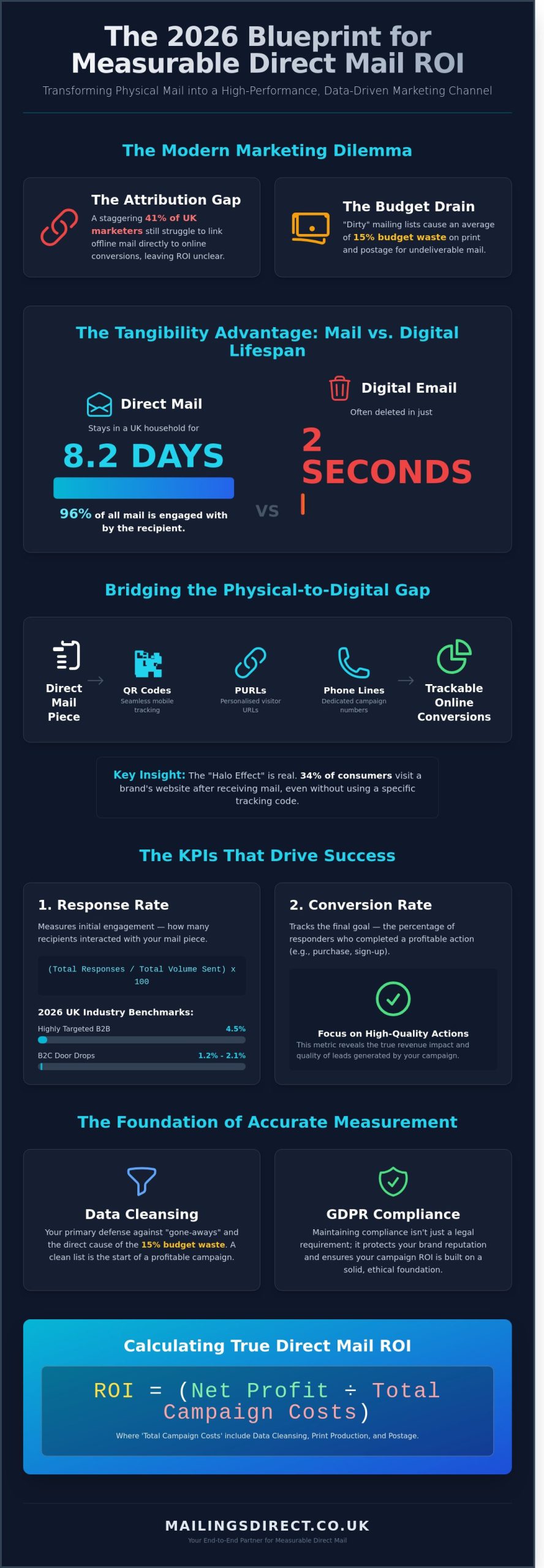
According to JICMAIL’s 2024 Annual Report, 96% of all household mail is engaged with, yet a recent industry survey found that 41% of UK marketers still struggle to link offline mail to online conversions. You’ve likely felt the frustration of seeing a spike in web traffic after a door drop but failing to prove the direct connection. Measuring direct mail effectiveness shouldn’t feel like guesswork, especially when postage and print costs require a clear justification of every pound spent. We understand that “dirty” mailing lists often lead to a 15% waste in budget, which creates unnecessary boardroom scepticism.
You’re right to demand the same level of precision from your post as you do from your digital dashboards. This guide provides a robust framework to accurately track, calculate, and optimise the ROI of your physical campaigns using modern attribution techniques and data-driven insights. We’ll walk you through the technical processes of data cleansing, seamless QR integration, and the specific reporting metrics that turn tangible mail into a predictable, high-performance marketing channel for your 2026 strategy.
Key Takeaways
- Understand why the “tangibility advantage” of physical mail extends your attribution window and provides longer-lasting consumer engagement than digital ads.
- Master the primary KPIs for measuring direct mail effectiveness, ensuring you can accurately distinguish between initial response rates and final revenue conversion.
- Learn how to bridge the gap between physical letters and online actions using modern attribution tools like QR codes for seamless mobile tracking.
- Identify why data cleansing is your best defence against “gone-aways” and how maintaining GDPR compliance protects your campaign ROI.
- Discover the benefits of using an end-to-end fulfilment partner to maintain tracking integrity and secure significant savings on your postage costs.
Why Measuring Direct Mail Effectiveness is Essential in 2026
Direct mail effectiveness represents the measurable impact of physical mail on consumer behaviour and bottom-line revenue. In the 2026 UK market, this metric has moved beyond simple response rates. It now encompasses the entire journey from the letterbox to the final transaction. Direct mail, also known as advertising mail, provides a physical bridge to your customers that digital channels cannot replicate. We define effectiveness by how well a campaign drives specific, profitable actions while maintaining a low cost-per-acquisition.
The “Tangibility Advantage” remains a primary reason why physical mail outperforms digital alternatives in longevity. While a marketing email is often deleted within two seconds, JICMAIL data from late 2025 indicates that the average piece of direct mail remains in a UK household for 8.2 days. This extended shelf-life significantly alters your attribution windows. It allows for multiple “re-reads” and shared viewing among household members, creating a sustained brand presence that digital ads lack. Measuring direct mail effectiveness requires capturing these delayed conversions that occur days or weeks after the initial delivery.
Relying on vanity metrics like “items posted” or “gross reach” is no longer sufficient for 2026 budget approvals. Marketing managers now face stricter scrutiny regarding postage spend and fulfillment costs. Precision measurement is the only way to justify the investment in high-quality litho printing or bespoke mailers. You must focus on customer lifetime value (CLV) and incremental lift to prove that your physical mail is driving genuine business growth rather than just duplicating digital efforts.
Direct Mail vs Digital: The Attribution Challenge
Direct mail often triggers a “halo effect” where the physical prompt leads a customer to convert via search engines or social media. Recent 2025 studies showed that 34% of UK consumers visited a brand’s website after receiving a flyer, even if they didn’t use the provided discount code. This creates an attribution challenge that requires a unified strategy. You cannot view mail in isolation; it’s a high-impact catalyst within a multi-channel funnel. Tracking these cross-channel movements ensures your data reflects the true influence of your print spend.
The Financial Impact of Precise Measurement
Precise tracking allows your business to adopt a “fail fast” methodology. By analysing real-time response data from small test batches, you can reallocate budgets toward high-performing segments before committing to a national rollout. This agility prevents wasted postage on unresponsive demographics. We define ROI in the context of direct mail as the ratio of net profit to total campaign costs, including data cleansing, print production, and final delivery. Measuring direct mail effectiveness through this financial lens ensures every penny of your marketing budget is working toward a specific, bankable result.
Key Performance Indicators (KPIs) for Direct Mail Success
Precision in measuring direct mail effectiveness starts with selecting metrics that align with your commercial objectives. We don’t just look at how many items leave the warehouse. We track how many items drive action. Reliable data allows marketing managers to move from speculative spending to predictable investment. By establishing clear KPIs, you transform a physical mailer into a trackable digital asset that fits perfectly within your wider reporting structure.
Primary Metrics: Response and Conversion
Distinguishing between engagement and revenue is vital for campaign clarity. A response rate measures how many recipients interacted with your mail piece. You calculate this by dividing total responses by the total volume sent and multiplying by 100. Use unique identifiers like QR codes, dedicated phone lines, or personalised URLs (PURLs) to capture this data accurately. In 2026, UK industry benchmarks indicate that highly targeted B2B campaigns achieve a 4.5% response rate, while B2C door drops often see 1.2% to 2.1%.
A conversion rate is different. It tracks the percentage of those responders who completed a specific goal, such as a £500 purchase or a service sign-up. This SBA guide to direct mail highlights that physical mail often drives higher conversion quality than digital alternatives because of its tactile nature. Tracking these separately helps you identify if a campaign had a great creative hook (high response) but a weak offer (low conversion).
Advanced Metrics: ROI and Lifetime Value (LTV)
Calculating your Return on Investment (ROI) requires a transparent view of all costs. Use this formula to stay in control of your budget:
- Step 1: Add up all costs, including data cleansing, litho printing, fulfillment, and postage.
- Step 2: Subtract this total cost from the total revenue generated by the campaign.
- Step 3: Divide that figure by the total cost and multiply by 100 to get your percentage.
We help clients lower their Cost Per Acquisition (CPA) by utilising Mailsort and other Royal Mail wholesale discounts. These postage savings often improve ROI by 15% or more compared to standard rates. While immediate ROI is important, Lifetime Value (LTV) is the superior metric for long-term strategy. If a direct mail piece acquires a customer who stays for five years, the initial CPA becomes a minor fraction of the total revenue generated. Integrating these figures into your CRM dashboard ensures your physical mailings are as measurable as any PPC campaign. Our team can help you optimise your postage strategy to ensure your KPIs remain healthy and your margins stay protected.
Modern Attribution Techniques: Tracking the Physical-to-Digital Journey
Measuring direct mail effectiveness no longer relies on guesswork or vague estimates. Modern campaigns use integrated technology to track a recipient’s journey from their letterbox to your checkout page with industrial precision. By bridging the gap between physical touchpoints and digital actions, you gain a clear view of your return on investment (ROI) across every postcode targeted.
Digital Bridges: QR Codes and PURLs
QR codes have seen a massive resurgence in the UK, with 2025 consumer data showing that 89% of adults now interact with them regularly. For maximum impact, place your QR code in a prominent position and surround it with a clear, benefit-driven call to action (CTA). Don’t just say “scan here”; instead, use “Scan for your £10 discount.” This clarity drives immediate mobile attribution.
Personalised URLs (PURLs) provide an even deeper level of engagement data. These bespoke web addresses direct individuals to a unique landing page pre-filled with their specific details. PURLs often result in a 25% uplift in conversion rates because they remove friction from the user experience. We integrate this tracking data directly into your CRM, allowing your sales team to receive real-time alerts the moment a high-value prospect lands on their personalised page.
Offline Tracking: Unique Codes and Dedicated Lines
Retailers and e-commerce brands use bespoke coupon codes to monitor redemptions across different channels. These alphanumeric strings allow you to track whether a customer purchased online, over the phone, or in a physical store. Dedicated phone numbers, or DDIs, offer similar insights for service-based businesses. By assigning a unique number to different demographic segments, you can identify which age groups or regions respond most frequently to your messaging. Unique codes help identify which specific mailing list performed best by attributing every single redemption to its original data source, ensuring your future spend is allocated to the most profitable segments.
The “Match-Back” Analysis Method
Match-back analysis remains the gold standard for measuring direct mail effectiveness in sectors with long sales cycles, such as B2B services or high-value charity fundraising. This process involves a direct reconciliation of your sales database against the original mailing list after a set period, typically 60 to 90 days. It uncovers “halo effect” sales where a customer received the mailer but chose to purchase through a different, untracked channel.
Handling this data requires strict adherence to UK regulations. We manage the entire reconciliation process using secure data cleansing techniques to ensure full GDPR compliance. This methodical approach provides a dependable audit trail, proving the tangible impact of your physical mail on your bottom line without compromising recipient privacy.
The Foundation of Measurement: Data Cleansing and GDPR
You can’t achieve precision when your starting point is flawed. Inaccurate data remains the primary obstacle to measuring direct mail effectiveness. If your database contains “gone-aways” or deceased records, your response metrics will never reflect the true performance of your creative or offer. Data decays at a rate of roughly 15% to 25% per year in the UK as people move house, change names, or pass away. When 10% of your mail pieces fail to reach the intended recipient, your calculated response rate is suppressed by a false denominator. You’re essentially penalising your campaign for reaching an empty letterbox.
Dirty data inflates your “cost per acquisition” (CPA) and wastes physical resources. If you send 5,000 items at a cost of £0.60 each, and 500 are sent to invalid addresses, you’ve wasted £300 before the first response arrives. Professional cleansing identifies these “gone-aways” before the printing stage. This ensures your metrics are based on valid prospects who actually had the opportunity to engage with your brand.
How Data Cleansing Improves Measurement Accuracy
Removing duplicates is the first step toward a single source of truth. Without this, a single customer might receive three identical vouchers, but only use one. This skews your attribution and makes the campaign appear less efficient than it truly is. We utilise the Mailing Preference Service (MPS) to refine your list, ensuring you only target individuals who are open to receiving physical mail. Data reveals that using professional data cleansing services can save 20% on postage by removing invalid records before they enter the postal stream. This lean approach provides a cleaner dataset for your post-campaign analysis.
- Suppression Files: Removing deceased or moved records to protect brand reputation.
- PAF Validation: Checking every address against the Royal Mail Postcode Address File.
- Deduplication: Ensuring your budget isn’t wasted on multiple mailers to the same household.
GDPR and Data Security in 2026
Measurement techniques must respect recipient privacy. In 2026, consumer awareness regarding data rights is at an all-time high. Measuring effectiveness requires a secure flow of information between your CRM and your mailing house. We use encrypted SFTP transfers to ensure your customer data is never exposed during the cleansing or fulfilment process. This security protects your brand from the catastrophic reputational damage of a data breach.
The “Legitimate Interest” clause under UK GDPR provides a robust framework for measuring direct mail. It allows businesses to process data for marketing purposes provided the privacy impact is minimal and the interest is balanced. By maintaining high data integrity, you demonstrate that your measurement practices are ethical and compliant. This builds trust with your audience, which ultimately leads to higher long-term engagement rates and more reliable data for future campaigns.
Maximising Results with Mailings Direct
Accurate measurement starts long before the first letter hits a doormat. At Mailings Direct, we simplify the process of measuring direct mail effectiveness by providing a cohesive, end-to-end service that eliminates the variables that often lead to data leakage. When you use multiple suppliers for design, print, and dispatch, tracking codes can easily be mismatched or lost. Our one-stop shop model ensures that every unique identifier remains tied to the correct recipient throughout the entire production cycle, providing a seamless link between your database and the physical mail piece.
We provide the technical infrastructure that allows UK businesses to track performance with surgical precision. By managing every stage under one roof, we remove the friction that typically complicates attribution. This integrated approach means your marketing team spends less time reconciling spreadsheets and more time analysing the high-level insights that drive future strategy. Our role is to act as your dependable industrial partner, ensuring that the logistical execution of your campaign is as sharp as your creative vision.
End-to-End Fulfilment and Precise Tracking
Precision is the foundation of any measurable campaign. Our facility handles both high-speed machine enclosing and intricate hand fulfilment for bespoke items, ensuring your tracking mechanisms remain intact and functional. Whether you are using a unique QR code or a personalised landing page, our “safe pair of hands” approach guarantees that 100% of your mail pieces are dispatched with the correct data attributes. You can see how our direct mail marketing expertise drives measurable growth by maintaining this rigorous data integrity from the moment your data is cleansed to the second it enters the postal system.
Reducing Costs to Boost Your ROI
The financial side of measuring direct mail effectiveness relies heavily on your initial outlay. We leverage our postage expertise to significantly lower your cost per acquisition. By utilising Mailsort and Downstream Access (DSA) providers, we typically reduce postage costs for our clients by up to 32% for bulk mailings. High-quality litho printing also ensures that your 2026 campaigns achieve a 4.4% average response rate, which far exceeds the industry standard for cluttered digital channels. This combination of lower costs and higher engagement directly improves your bottom line and makes your ROI figures much more impressive to stakeholders.
Ready to see the numbers? Get a quote for your next measurable campaign today and let us handle the logistics while you focus on the results.
Future-Proof Your Direct Mail Strategy
Success in the 2026 landscape requires more than just sending mail; it demands an end-to-end strategy built on precise data. By integrating QR codes and personalised URLs, you bridge the gap between tangible post and digital conversion. This ensures that measuring direct mail effectiveness becomes a rigorous science rather than guesswork. Maintaining GDPR-compliant data isn’t just a legal necessity; it’s a financial one. Clean lists can reduce mailing wastage by up to 15% and protect your brand reputation across the United Kingdom.
Mailings Direct provides the technical infrastructure and over 20 years of UK mailing expertise needed to execute these complex campaigns. We handle everything from data cleansing to fulfilment with the precision of a high-capacity industrial partner. Our clients benefit from significant savings on bulk postage rates, often reducing delivery costs by 30% or more compared to standard Royal Mail tariffs. We take the stress out of logistics so you can focus on your ROI. We’ve seen every shift in the industry and know how to navigate the postal system’s complexities for you.
Request a bespoke quote for your next direct mail campaign and let us deliver a reliable, cost-effective solution for your business. We’re ready to help you turn physical mail into measurable growth.
Frequently Asked Questions
How do I track direct mail if I don’t have a website?
You can track your campaign offline by using dedicated telephone numbers or unique physical offer codes. A 2024 study by JICMAIL shows that physical mail stays in a household for 7 days on average, so using a specific phone line allows you to log every enquiry directly. You might also use “bring-in” vouchers for retail locations to track conversions without any digital interface.
What is a good response rate for a direct mail campaign in the UK?
A strong response rate for UK direct mail typically ranges between 3% and 5% for existing house lists and 1% for cold prospecting. According to 2025 industry benchmarks, highly personalised campaigns often achieve rates as high as 9%. Measuring direct mail effectiveness depends on your specific sector, but these figures provide a reliable baseline for your ROI projections.
Can I use A/B testing with direct mail postcards?
You can use A/B testing by splitting your mailing list into two equal segments of 500 or more records. Test a single variable such as a £10 discount versus a 20% off offer to see which drives more action. We handle the split-run printing and fulfillment to ensure each group receives the correct version for accurate measurement and comparison.
How long should I wait before measuring the final results of my campaign?
You should wait at least 21 days after the final drop date before calculating your final campaign metrics. While 80% of responses typically arrive within the first 14 days, JICMAIL data indicates that items are often revisited several times over a three-week period. This window ensures you capture the full lifecycle of the physical mailer before closing the report.
How much does it cost to add QR codes or PURLs to my mailers?
Adding a standard QR code is free as it’s part of your digital artwork, while dynamic PURLs typically add between £0.02 and £0.05 per item to your fulfillment costs. These tools are essential for measuring direct mail effectiveness as they provide real-time digital tracking data. For a campaign of 5,000 items, you should expect a total setup fee of approximately £150.
Is match-back analysis GDPR compliant?
Match-back analysis is fully GDPR compliant when conducted using “Legitimate Interest” as the legal basis for processing. You must ensure your privacy policy covers this activity and use a secure data processor for the comparison. We process all data in line with the 2018 Data Protection Act to keep your campaign secure and legally sound at every stage.
What is the difference between Cost Per Lead and Cost Per Acquisition?
Cost Per Lead (CPL) measures the expense of generating an initial enquiry, whereas Cost Per Acquisition (CPA) calculates the total spend required to secure a paying customer. If a £2,000 campaign generates 100 enquiries and 10 sales, your CPL is £20 and your CPA is £200. Understanding this distinction is vital for accurate budget allocation and determining your true profit margins.
How does data cleansing affect my campaign ROI?
Data cleansing can increase your ROI by up to 25% by removing deceased records and gone-aways before you pay for postage. In the UK, approximately 500,000 people move house every quarter, making address validation critical for any mailing. By eliminating undeliverable mail, you reduce wasted spend on print and fulfillment, ensuring your budget reaches active prospects only.