
If your marketing budget is under scrutiny, sending mail without a clear attribution model is a risk you don’t need to take. While JICMAIL data indicates that 95% of mail is engaged with by householders, many UK marketing managers still find themselves guessing when it comes to the final sale. It’s frustrating to see a spike in web traffic following a campaign but have no way to prove the physical post caused it. Mastering how to track direct mail conversions is the only way to move from vague response rates to the precise financial reporting your stakeholders demand.
You already know that physical mail delivers a high-impact, tactile experience that cuts through digital clutter. However, the pressure to demonstrate a precise return on investment is higher than ever. Discover the precise methods and technologies used to bridge the gap between the letterbox and the checkout page to measure your exact ROI. This guide provides a clear framework for attribution, comparing the effectiveness of QR codes against personalised URLs (PURLs) so you can report your results with total confidence. We’ll outline the end-to-end process for making your mailings as measurable as any digital channel, ensuring every pound spent is accounted for.
Key Takeaways
- Learn the critical distinction between engagement and revenue to ensure you are measuring the true ROI of your physical mail campaigns.
- Discover how to track direct mail conversions by deploying the most effective physical triggers, from generic QR codes to bespoke Personalised URLs (PURLs).
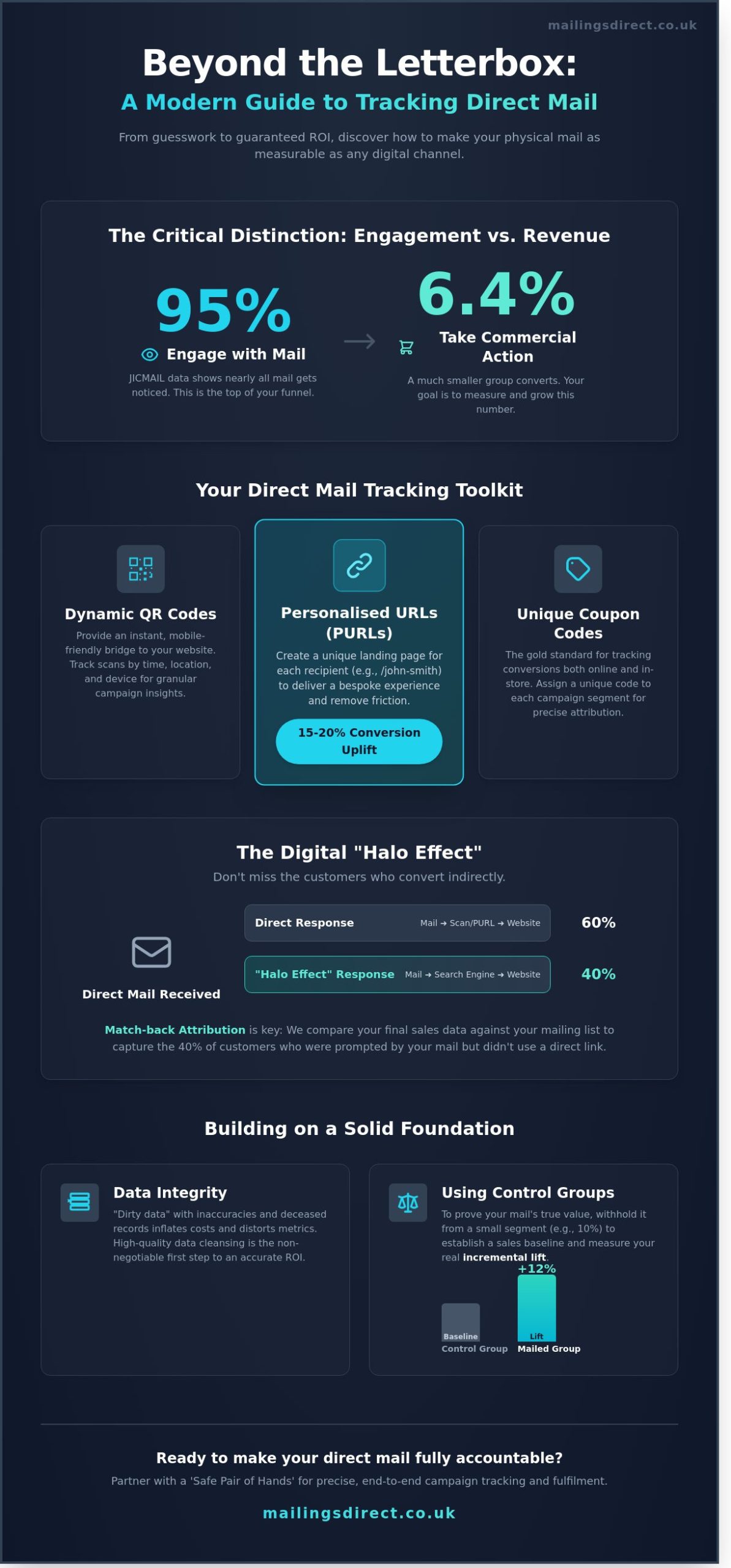
- Master match-back attribution to account for the “Halo Effect,” capturing the 40% of customers who visit your website via search engines after receiving your post.
- Ensure reporting accuracy by identifying how “dirty data” and deceased records can inflate costs and distort your conversion metrics.
- Follow a practical implementation checklist to seamlessly integrate tracking elements into your next campaign in partnership with your mailing house.
Understanding the Direct Mail Tracking Framework
Effective direct mail tracking connects a physical delivery to a specific, measurable action. In the past, marketers often relied on guesswork. By 2026, the UK industry has shifted toward absolute precision. Modern Direct marketing campaigns now function as part of an integrated digital ecosystem. We define tracking as the ability to attribute a sale or lead directly to the piece of post that landed on a customer’s doormat. It removes the ambiguity from your marketing spend and provides a clear audit trail for every penny of your postage budget.
Many UK businesses now use a “Control Group” to measure success accurately. This involves withholding mail from a specific segment, often 10% of a target audience, to establish a natural baseline of sales. If the mailed group shows a 12% increase in purchases compared to the control, that represents your incremental lift. It’s a rigorous way to prove ROI without relying on vanity metrics. Understanding how to track direct mail conversions starts with this comparison, ensuring you aren’t taking credit for sales that would have happened anyway.
Response vs. Conversion: Why the Distinction Matters
A response is an interaction, while a conversion is a result. If a recipient scans a QR code, they’ve responded. If they then spend £75 on your website, they’ve converted. You need to track both to understand the full customer journey. Micro-conversions, like newsletter signups or catalogue requests, provide early engagement data. Macro-conversions, such as a completed product purchase, fund your next campaign. JICMAIL data from 2024 shows that while 95% of mail is engaged with, only about 6.4% typically leads to a direct commercial action. Setting your KPIs against these UK benchmarks ensures your campaign expectations remain realistic and grounded in data.
The “Black Box” Myth: Why Direct Mail is Now Fully Measurable
The idea that mail is an untraceable “black box” is outdated. We use print-and-post technology that integrates directly with your CRM and GA4 analytics. This bridges the gap between the physical letterbox and the digital checkout. To achieve this, you need a “Safe Pair of Hands” for fulfilment. We ensure that every unique identifier, whether it’s a pURL or a bespoke discount code, is printed accurately and deployed on schedule. This level of technical precision turns a simple letter into a powerful data point. Learning how to track direct mail conversions effectively depends on high-quality data cleansing to ensure your triggers reach the right person at the right time. Our end-to-end service handles the complex logistics, so you can focus on the insights provided by your tracking dashboard.
Physical Tracking Triggers: QR Codes, PURLs, and Coupons
Direct mail isn’t a “send and hope” medium. To master how to track direct mail conversions, you must build a digital bridge into your physical creative. UK marketers now rely on three main physical triggers to capture data and attribute ROI accurately. Data from JICMAIL in 2023 suggests that 95% of mail is engaged with, but without a physical trigger, you can’t tell which specific recipient took action. Choosing the right trigger depends on your campaign goals and the complexity of your customer journey. Successful campaigns often use a combination of these methods to ensure no lead goes uncounted.
QR Codes and Personalised URLs (PURLs)
Dynamic QR codes provide granular data that static codes cannot match. They allow you to track scans by time, location, and device type in real time. This is particularly effective for postcards where space is limited and you want to drive immediate mobile engagement. Personalised URLs (PURLs) take this a step further by creating a unique landing page experience for every recipient, such as mailingsdirect.co.uk/john-smith. This level of detail removes friction and makes the recipient feel valued. It also enables “abandoned cart” style follow-ups. If a recipient visits their PURL but doesn’t complete the transaction, your CRM captures that intent. You can then trigger a secondary mailer or a targeted email to close the deal. This approach often results in a 15% to 20% uplift in final conversions compared to generic landing pages.
Unique Coupon Codes and Dedicated Phone Lines
Unique alphanumeric codes remain the gold standard for tracking conversions in-store or through e-commerce platforms like Shopify and Magento. By assigning a specific code to each segment, you identify exactly which mailing list performed best. For high-value services like charity donations or legal enquiries, dedicated call tracking numbers are essential. Assigning a unique 0800 or local number to your mailer ensures every phone lead is attributed to the correct campaign. It’s a simple way to optimise your postage spend by cutting lists that don’t generate calls. Placing these triggers near a clear, bold Call to Action (CTA) is vital. Use high-contrast colours and active verbs like “Claim” or “Redeem” to guide the recipient’s eye. A well-placed coupon code on a 300gsm silk postcard provides a tactile reminder of the offer, keeping your brand on the recipient’s mantelpiece for an average of seven days.
Learning how to track direct mail conversions effectively involves testing these physical triggers against one another to see what resonates with your specific UK audience. You might find that a QR code works best for a younger demographic, while a dedicated phone line is preferred by older customers seeking reassurance. By measuring the response rate of each trigger, you can refine your creative strategy for future mailings, ensuring every penny of your marketing budget is working as hard as possible.
The Digital “Halo Effect” and Match-back Attribution
Direct mail doesn’t operate in a silo. It creates a “Halo Effect” that ripples through your other marketing channels, driving significant digital activity that often goes uncredited. While trackable links and QR codes provide immediate data, they don’t capture the full journey. Research from JICMAIL indicates that 40% of recipients visit a brand’s website via a search engine after receiving mail, rather than using the specific URL provided. If you rely solely on direct response codes, you’re underreporting your campaign’s success. Understanding how to track direct mail conversions involves capturing this invisible traffic that migrates from the doormat to the search bar.
Physical mail acts as a tangible reminder that stays in the home for an average of 8.2 days. This longevity drives repeated digital interactions over a week or more. A recipient might see your postcard on Tuesday but only search for your services on Friday evening. Without a broader attribution strategy, that conversion appears as “Organic Search” or “Direct” traffic in your reports, obscuring the mail’s actual contribution to your bottom line. We bridge this gap by using data-driven methodologies to prove the link between the physical and the digital.
Analysing Direct and Organic Search Spikes
Google Analytics 4 (GA4) is a vital tool for identifying these hidden conversions. We recommend setting up “Custom Segments” to isolate traffic from the specific UK postal regions targeted in your campaign. By comparing traffic from these postcodes against your national average, you can identify clear geographic spikes. Focus your analysis on the 14-day “time-window” following your delivery date. This peak period typically sees the highest concentration of mail-driven activity. Look for increases in “New Users” and “Direct” sessions that correlate with your postage dates to validate your campaign’s reach.
Match-back Analysis: The Professional Standard
A Post-Campaign Audit is the most reliable method for verifying ROI. This involves cross-referencing your original mailing list with your sales database after the campaign ends. By matching customer addresses, you can identify exactly who made a purchase, even if they didn’t use a tracking code. This process requires rigorous data cleansing and strict adherence to GDPR regulations. We use secure, encrypted environments to ensure that personal data remains protected throughout the audit. This approach provides a clear view of your “Total Lift” by comparing mailed segments against a control group.
- Calculate Total Lift: Compare the conversion rate of your mailed segment against a “control group” of customers who received no mail to see the true incremental value.
- Identify Latent Conversions: Capture sales that occurred weeks after the initial delivery, which would otherwise be missed by short-term tracking.
- Refine Future Targeting: Use the match-back data to see which specific postcodes or demographics delivered the highest return on investment.
This methodology provides a concrete figure for your campaign’s performance, showing the exact sales generated by the mail. It’s a pragmatic, no-nonsense approach that moves beyond guesswork and delivers the precision that modern UK marketing managers require.
Data Integrity: The Hidden Variable in Conversion Tracking
Accuracy in reporting depends entirely on the quality of your mailing list. If your database contains “dirty data,” your conversion metrics will be fundamentally flawed from the outset. UK address data decays at a rate of approximately 15% per year as people move house, change names, or pass away. When you fail to account for these variables, you waste postage and dilute your performance data. Professional data cleansing ensures you only measure reachable prospects; this is the first step in learning how to track direct mail conversions with precision.
Sending mail to “gone-aways” or deceased records does more than just hurt your ROI; it creates a “ghost” population in your denominator. If your campaign targets 10,000 households but 1,200 of those are no longer at that address, your reported conversion rate is artificially suppressed. We recommend a multi-stage screening process that includes the Post Office Address File (PAF) and the Mortascreen database. This ensures your budget is focused on active leads rather than empty letterboxes. It’s a simple calculation: removing 1,000 dead records before mailing saves you roughly £550 in postage and production costs at current market rates.
Data Cleansing as a Measurement Tool
Clean data provides a stable baseline for your analytics. Removing duplicates prevents the double-counting of conversions which often occurs when one household receives multiple mailers. We cross-reference your lists against the Mail Preference Service (MPS) to ensure compliance and refine your “True Reach.” A 2% conversion rate on a verified list of 5,000 records provides far more actionable insight than a 1% rate on a bloated list of 10,000. Precision beats volume every time.
Postage Management and Delivery Confirmation
Modern tracking relies on Royal Mail’s Mailmark technology. This system uses 2D barcodes to provide batch-level reporting, showing you exactly when your mail enters the delivery network. This level of visibility is essential for anyone looking at how to track direct mail conversions across multiple UK regions simultaneously. Knowing your “Delivery Window” allows you to synchronise digital follow-up ads or email sequences within 24 hours of the physical arrival. You can link these delivery confirmations directly to your CRM; this triggers real-time alerts for your sales team to follow up while the brand is still fresh in the recipient’s mind.
Implementation Guide: Setting Up for Success
Establishing a robust framework for your campaign ensures that no data points are lost between the letterbox and the laptop. Success in modern physical marketing depends on knowing exactly how to track direct mail conversions through a structured implementation process. You can’t leave tracking to chance; it must be baked into the campaign from the initial data export.
Use this checklist to prepare your next mailing:
- Data Validation: Run your list through the Royal Mail Postcode Address File (PAF) to ensure 100% deliverability.
- Unique ID Assignment: Assign a specific alphanumeric string to every recipient in your database before sending it to the printer.
- VDP Calibration: Work with your mailing house to ensure Variable Data Printing (VDP) fields align perfectly with your design templates.
- The “Tracking-First” Brief: Instruct your design team to treat the QR code or PURL as the primary Call to Action. Ensure a 15mm “quiet zone” surrounds every QR code to maintain scanability.
- The Final Audit: Never skip the physical proofing stage. We recommend scanning 10 to 15 physical proofs using both iOS and Android devices to verify that the redirect logic holds up before the full print run begins.
Integrating Direct Mail with Your CRM
Modern marketing doesn’t exist in a vacuum. You should connect your mailing house data directly to platforms like Salesforce, HubSpot, or Microsoft Dynamics to close the loop. By importing your unique tracking codes into your CRM, you can automate the “Lead Source” field. When a customer scans their code, the CRM identifies the individual and updates their record instantly. This eliminates the 25% margin of error often found in manual data entry. You can then build a unified dashboard to view physical and digital conversions in one place, providing a clear picture of your multi-channel performance. This integrated view is the most reliable way to understand how to track direct mail conversions while maintaining a high ROI.
Choosing an “End-to-End” Mailing Partner
Managing multiple vendors for data, print, and fulfilment often leads to technical fragmentation. A single “end-to-end” provider eliminates these friction points by handling the entire lifecycle of the mail piece. At Mailings Direct, we manage the technical complexity of bespoke tracking, from data cleansing to the precision application of unique QR codes. We help you navigate the complexities of UK postal weights and sizes to ensure your trackable mail is as cost-effective as possible. Our “safe pair of hands” approach means we catch technical errors in the data stage before they become expensive mistakes at the letterbox. If you’re ready to launch a campaign that delivers measurable results, get a bespoke quote for your next trackable campaign and let us handle the logistics.
Take Control of Your Direct Mail Performance
Direct mail is no longer a “send and hope” medium. By integrating physical triggers like QR codes with robust match-back attribution, you gain a clear view of your return on investment. You’ve now seen exactly how to track direct mail conversions by bridging the gap between offline mailers and digital actions. Success depends on data integrity; even a 5% error rate in your mailing list can skew your results and waste your marketing budget.
Mailings Direct provides the end-to-end support needed to execute these complex strategies. We bring over 20 years of UK mailing expertise to every project, ensuring your campaigns are both impactful and measurable. Our ISO 9001 Certified Quality Management systems guarantee precision, while our GDPR-compliant data cleansing removes the variables that compromise your tracking accuracy. We handle the technical logistics and postage requirements so you can focus on your strategy.
Stop guessing your campaign performance and start measuring it with confidence.
Request a Free Quote for Your Next Direct Mail Campaign
Frequently Asked Questions
How do you track direct mail conversions if the customer doesn’t use a code?
You track these conversions through match-back reporting, which compares your mailing list against sales data during a specific period. By matching customer names or postcodes from your CRM to your dispatch list, you can identify “halo effect” conversions that occurred without a code. A 2024 JICMAIL study suggests that 35% of mail items drive website visits even without a direct incentive, making this reconciliation process essential for accurate attribution.
What is a good conversion rate for a UK direct mail campaign in 2026?
A benchmark conversion rate for UK direct mail in 2026 sits between 2% and 5% for targeted campaigns. While cold acquisition often yields 1%, highly personalised mailings to existing customers can exceed 10%. These figures depend on your sector and offer. Recent industry data shows that physical mail achieves a 40% higher response rate than email, as tangible items remain in the home for an average of 7 days.
Can I track direct mail in Google Analytics?
You can track direct mail in Google Analytics by using vanity URLs or QR codes embedded with UTM parameters. When a recipient scans a code, the source is recorded as “direct_mail” and the medium as “print” within your GA4 dashboard. This allows you to monitor exactly how to track direct mail conversions alongside your digital channels. It provides a seamless view of user behaviour, session duration, and final purchase paths originating from physical post.
What is the difference between a PURL and a QR code?
A PURL is a Personalised URL unique to an individual recipient, such as “mailingsdirect.co.uk/john-smith,” whereas a QR code is a scannable matrix barcode that links to a destination. PURLs offer a highly bespoke experience and allow you to track individual engagement without a scan. QR codes are more common now, with 85% of UK smartphone users scanning at least one code in 2024 to access promotions or digital content.
How long should I wait to measure the results of my mailing?
You should wait at least 14 to 21 days after the final mail drop before conducting your primary analysis. While 60% of responses typically occur within the first 7 days, direct mail has a long tail. JICMAIL research confirms that mail is often revisited 4 or 5 times over a month. Final campaign performance shouldn’t be set in stone until 30 days post-dispatch to ensure every delayed conversion is captured.
Does data cleansing really affect my conversion tracking?
Data cleansing is vital because it removes deceased records and gone-aways that skew your response percentages. If 5% of your 10,000-piece mailing is sent to incorrect addresses, your conversion data becomes fundamentally inaccurate. We use PAF (Postal Address File) and MPS (Mailing Preference Service) checks to ensure your list is 100% compliant. This process reduces wastage and ensures your ROI calculations are based on successfully delivered items only.
Is it possible to track phone calls generated by direct mail?
You can track phone responses by printing a unique virtual tracking number on your mail pieces. This number redirects to your main line while logging the call source and duration in your reporting software. It’s a reliable way to understand how to track direct mail conversions for high-value services where customers prefer to speak to an expert. In 2024, call tracking revealed that 15% of service-based enquiries originated from physical mailers.
How much does it cost to add unique tracking codes to my mail pieces?
Adding unique tracking codes typically adds less than 1p to 2p per item to your total production cost. This is managed through variable data printing (VDP), which allows us to customise every single mailer with a bespoke code or PURL. For a standard run of 5,000 leaflets, the setup fee might start around £50. This small investment provides the granular data needed to refine future campaigns and improve your overall marketing efficiency.