
While digital inboxes are saturated, 95% of UK mail is engaged with by recipients, according to 2023 JICMAIL research. You likely appreciate the tactile power of a physical mailshot, but you’re probably tired of the struggle to attribute offline actions to online conversions. It’s difficult to justify the spend when complex postage rates and VAT rules make the initial cost appear higher than a simple email blast. Mastering how to calculate direct mail roi uk is the only way to move from guesswork to a data-driven strategy that satisfies your directors and proves your marketing value.
This guide delivers the precise formulas and tracking mechanisms used by industry experts to measure success and identify where costs can be trimmed. We will show you how to lower your investment through smart data cleansing and fulfilment efficiencies, ensuring your next campaign is both measurable and highly profitable. By the end of this article, you’ll have a repeatable framework to report your results with absolute confidence. We’ll break down the specific components of a UK mail campaign, from litho printing costs to wholesale postal discounts, so you can see exactly where your money goes and what it returns.
Key Takeaways
- Identify the four pillars of campaign spend—data, creative, production, and postage—to ensure your total investment is calculated with absolute precision.
- Learn exactly how to calculate direct mail roi uk using professional formulas that account for both immediate response rates and long-term customer lifetime value.
- Discover the top five tracking and attribution methods used by leading UK marketers to accurately link revenue back to your physical mailings.
- Maximise your returns by implementing rigorous data cleansing to eliminate “ROI leakage” caused by sending mail to outdated addresses or “gone-aways”.
- Establish a clear break-even target before your campaign launches to ensure a “safe pair of hands” approach to your end-to-end mailing strategy.
Understanding the Direct Mail ROI Framework in the UK
Direct mail ROI measures the specific profit your business generates relative to your total campaign spend. It’s the most reliable way to prove the value of your marketing budget. While digital channels often struggle with 0.1% click-through rates and high “ad fatigue,” physical mail provides a tangible connection that commands attention. Data from JICMAIL in 2023 indicates that 95% of all household mail is engaged with, whether it’s opened, read, or put aside for later. This high engagement level makes physical campaigns a dependable driver for a strong Return on Marketing Investment compared to the fleeting nature of social media ads.
Accurate measurement requires you to look past simple engagement. You must distinguish between your “Response Rate” and your “ROI.” A response rate tells you how many people took an action, such as visiting a landing page or calling a sales line. ROI tells you if those actions actually made you money. If a campaign costs £1,000 and generates 100 leads but zero sales, your response rate is high, but your ROI is -100%. We provide the data cleansing and targeting expertise to ensure your mail reaches the right letterboxes, shifting the focus from vanity metrics to bottom-line profitability.
Why ROI Tracking is Different for Physical Mail
Physical mail stays in a UK home for an average of 7 days, often resting on a kitchen counter or hallway table. This “tangibility factor” means the conversion window is much longer than a digital click. You won’t always see an immediate spike in traffic; there’s a natural lag time while the householder considers your offer. Unlike digital ads that disappear when the budget runs out, a well-printed brochure continues to work for you days after delivery. Successful UK SMEs track this over a 30 to 60-day window to capture the full financial impact of the campaign.
The Basic ROI Formula with a UK Example
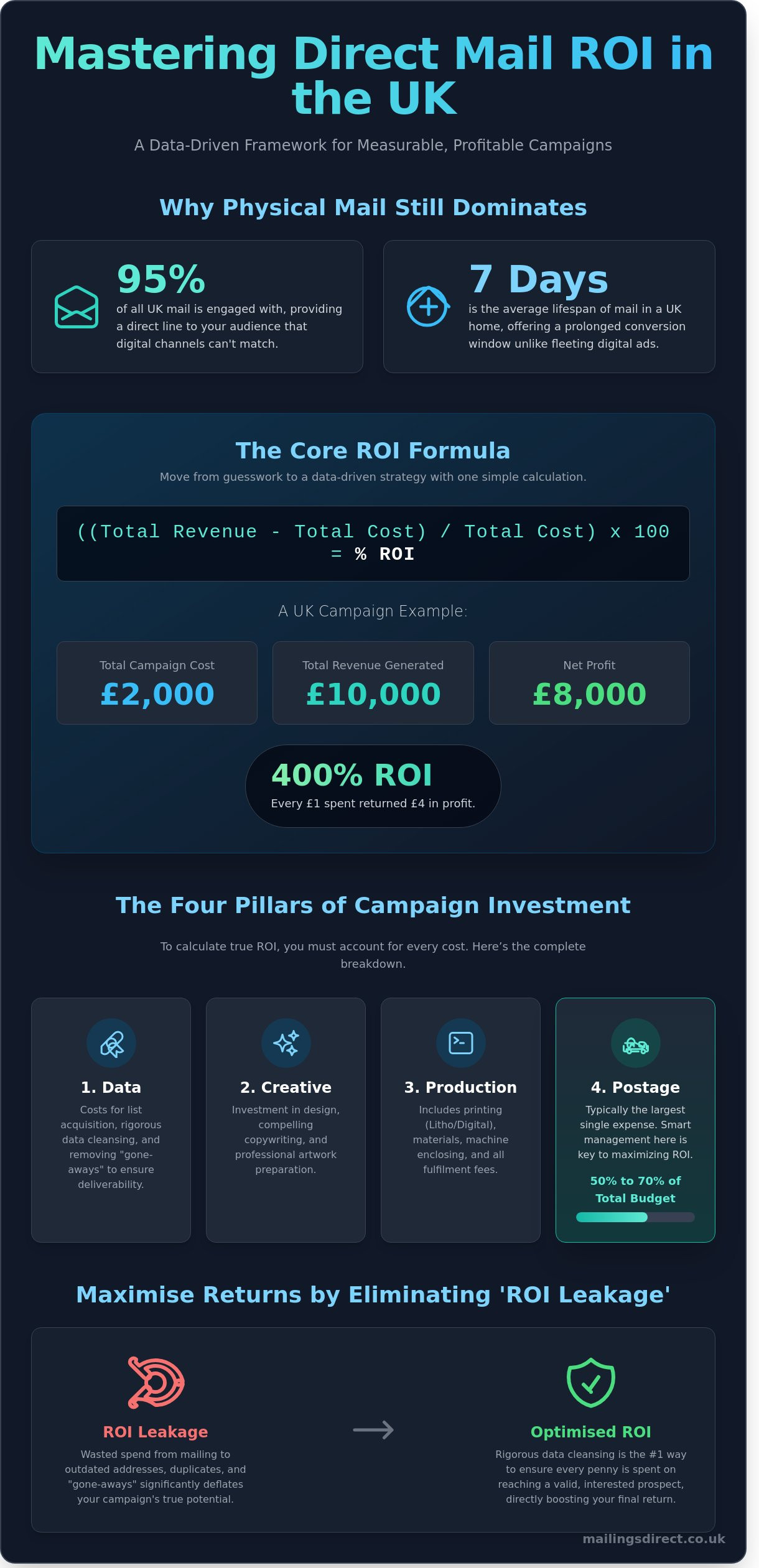
Understanding how to calculate direct mail roi uk starts with a simple, transparent formula: ((Total Revenue – Total Cost) / Total Cost) x 100. This calculation gives you a percentage that represents your campaign’s efficiency. Every pound you spend should be an investment in growth, not just an expense.
Consider a hypothetical campaign for a local service provider:
- Total Campaign Cost: £2,000 (Includes litho printing, postage, and fulfillment)
- Total Revenue Generated: £10,000
- Net Profit: £8,000 (£10,000 – £2,000)
- The Calculation: (£8,000 / £2,000) x 100 = 400% ROI
In this scenario, every £1 spent returned £4 in profit. By using this framework, you can compare the cost-effectiveness of different mail formats or geographic targets. We handle the end-to-end logistics to keep these costs low, ensuring your margins remain as wide as possible.
Step 1: Calculating Your Total Campaign Investment (The UK Cost Base)
Accurate financial tracking starts with a granular breakdown of every penny spent. You can’t determine how to calculate direct mail roi uk without a fixed view of your total investment. We categorise these costs into four essential pillars: data, creative, production, and postage. Ignoring even a small fulfilment fee will lead to an inflated ROI figure that doesn’t reflect reality.
Postage is almost always your largest single expense, often accounting for 50% to 70% of the total budget. It is also your most significant lever for financial improvement. You must also account for VAT. While standard Royal Mail stamps are VAT exempt, professional bulk mailing services and Downstream Access (DSA) providers charge VAT. If your business is VAT-registered, you can reclaim this 20% cost; if you are in a VAT-exempt sector like finance or healthcare, this cost remains a “sticking” expense that must be included in your ROI denominator.
Production and Fulfilment Costs
Printing expenses are dictated by volume and technology. Digital printing is ideal for personalised, short-run campaigns, but Litho printing becomes the more professional, cost-effective choice for runs exceeding 2,500 units. High-volume production can reduce unit costs by as much as 15%. Fulfilment fees also vary based on complexity. Machine enclosing is the most efficient method for standard letters. If your campaign requires hand-matching items or inserting bulky samples, costs will rise. For heavy catalogues, polywrapping offers a durable and lighter alternative to traditional envelopes, which helps keep your weight-based postage costs down.
Optimising UK Postage Rates
The most effective way to boost your ROI is to reduce the “Cost” variable through sortation. By using Mailsort, your mailing house pre-sorts your mail into specific postcode blocks before it even reaches the Royal Mail network. This reduces the manual handling required, allowing you to access wholesale rates. Utilising Downstream Access (DSA) providers can further reduce postage bills by up to 30% compared to standard retail rates. These savings directly improve your profit margins without requiring a single extra response. Our team can audit your current mailing profile to identify where these sortation savings can be applied to your next campaign.
Every pound saved during the production and postage phase lowers your break-even point. This makes your campaign more resilient to fluctuations in response rates and ensures your marketing budget works harder for the business.
Step 2: Tracking Responses and Attribution Methods
Tracking serves as the foundation of your ROI analysis. It provides the precise data required to determine the “Revenue” variable in your formula. Without robust tracking, any attempt to understand how to calculate direct mail roi uk becomes an exercise in guesswork. You must establish clear links between the physical mailpiece and the eventual transaction to prove the value of your spend.
In 2026, successful UK marketers prioritise five primary tracking methods to capture response data:
- Dynamic QR Codes: These allow for individual-level tracking and seamless digital transitions.
- Personalised URLs (PURLs): Unique web addresses tailored to each recipient.
- Dedicated Phone Lines: Using specific 0800 or local numbers to isolate call volumes.
- Unique Offer Codes: Alphanumeric strings that track redemptions at checkout.
- CRM Matchback: Cross-referencing sales data against the original mailing list.
You must also account for the “Halo Effect.” Data from JICMAIL suggests that 38% of recipients visit a brand’s website after receiving mail, but many do so via organic search rather than the provided link. Monitor your organic traffic and branded search volumes during the campaign window. If you notice a 15% uplift in search traffic that mirrors your mail drop dates, attribute a portion of that revenue to your direct mail efforts.
CRM integration delivers the most reliable results. By importing your mailing list into your CRM, you can perform a matchback analysis 30, 60, or 90 days after the drop. This process identifies customers who purchased through any channel after receiving your mail, even if they didn’t use a specific tracking code. This provides a comprehensive view of the campaign’s total impact on your bottom line.
Digital Bridges: QR Codes and PURLs
Dynamic QR codes are now a standard requirement for modern mailers. They allow you to track exactly which individuals scanned the code and when they did so. Personalised URLs (PURLs) offer a similar level of granularity but provide a more bespoke experience. When a recipient visits a PURL, you can pre-populate their details on a landing page, which typically increases conversion rates by 22% compared to generic URLs. Ensure your landing pages are mobile-first. Since 64% of UK recipients scan QR codes using their smartphones, a slow or non-responsive page will lead to immediate abandonment.
Offline Tracking: Unique Phone Numbers and Vouchers
For businesses that rely on phone enquiries or physical footfall, offline tracking is essential. Assign a dedicated local or 0800 number to your campaign to ensure every call is attributed correctly. This prevents mail-generated leads from being lost in your general enquiry data. Unique offer codes are equally effective for attributing sales at the point of purchase. If you operate a bricks-and-mortar shop, require the physical voucher for an in-store discount. This creates a tangible data trail that links a specific letterbox directly to a sale at the till.
Step 3: Calculating Actual vs. Expected ROI
Understanding how to calculate direct mail roi uk effectively requires you to look beyond the initial response rate. You must establish a baseline for success before the first item leaves the mailroom. This involves setting an “Expected ROI” based on your historic data or industry standards to measure against your “Actual” performance once the campaign concludes. By defining these metrics early, you move from speculative marketing to data-driven direct mail management.
The Break-Even Analysis
To find your break-even point, you simply divide your total campaign expenditure by the profit margin generated from a single sale. Knowing this specific figure reduces the perceived risk of direct mail because it provides a concrete target for your sales team. If a £5,000 campaign promotes a service with a £500 profit margin, you know with absolute certainty that 10 conversions make the project self-sustaining.
Formula: Total Campaign Cost / Profit Margin Per Sale
Establishing this figure allows you to assess the feasibility of your mailing. According to our postcard marketing guide, UK businesses often see response rates between 1% and 3.7% depending on the quality of the data cleansing and targeting. If your break-even point requires a 10% response rate, you’ll know to adjust your offer or reduce your production costs before the campaign launches.
Factoring in Customer Lifetime Value (LTV)
A campaign that only manages to break even on the first sale is often viewed as a failure by inexperienced marketers. However, for most UK businesses, the real profit lives in the repeat business. When you calculate direct mail roi uk, you should include the Customer Lifetime Value (LTV) to see the true impact on your bottom line. If a customer acquired today spends an average of £1,200 over the next 12 months, a £50 acquisition cost is an exceptional investment.
| Metric | Single Sale ROI | Year 1 LTV ROI |
|---|---|---|
| Acquisition Cost (CPA) | £45.00 | £45.00 |
| Average Profit per Sale | £50.00 | £150.00 (3 sales) |
| Total Net Profit | £5.00 | £105.00 |
This long-term perspective changes how you view your Cost Per Acquisition (CPA). In a mailing context, CPA is calculated by dividing your total campaign cost by the number of new customers gained. It’s a vital metric for comparing direct mail against digital channels like PPC or social media advertising. We’ve seen that while digital CPA can fluctuate wildly, physical mail remains a stable, predictable method for acquiring high-value clients.
Ready to improve your campaign efficiency? Get a professional quote for your next UK mailing and let us handle the logistics.
Optimising Your ROI: How to Squeeze More Value from Every Penny
Understanding how to calculate direct mail roi uk is only the first step. To truly maximise your returns, you must focus on what we call the “Safe Pair of Hands” approach. This strategy prioritises the reduction of waste to protect your profit margins. Every undelivered letter or irrelevant message is a direct hit to your bottom line. By tightening your processes, you ensure that your budget works harder, converting more prospects into paying customers without increasing your initial spend.
An end-to-end mailing house acts as a strategic partner in this process. We identify cost efficiencies that aren’t always obvious, such as adjusting paper weights to qualify for lower postage brackets or choosing litho printing for larger volumes to reduce unit costs. This comprehensive oversight removes the stress of logistics and ensures your campaign remains cost-effective from the first proof to the final delivery.
Data Hygiene: The Secret ROI Multiplier
Data cleansing is the most effective way to prevent “ROI leakage.” In the UK, approximately 15% of households move every year, meaning static lists degrade rapidly. Sending mail to “gone-aways” or deceased records doesn’t just waste the £0.35 to £0.60 spent on postage and production; it actively skews your results. We use deduplication and suppression files to ensure your message only reaches active, valid addresses.
- Postage Savings: Removing duplicate entries can reduce your total postage bill by 5% to 10% instantly.
- GDPR Compliance: Maintaining clean data is a vital risk-mitigation strategy. It protects your brand from the heavy fines associated with non-compliance, which can reach 4% of global turnover.
- Lower CPA: By targeting a refined list, your response rates naturally climb, which significantly lowers your Cost Per Acquisition (CPA).
Testing Your Way to Better Returns
When you know how to calculate direct mail roi uk accurately, you can begin to test variables to see what drives the highest revenue. We recommend the “Control” group method. By holding back a small percentage of your audience from receiving the mail, you can measure the true uplift in sales compared to those who didn’t see your campaign. This identifies exactly how much revenue the mailer generated versus organic growth.
Focus your testing on one variable at a time to get clear data. Try a bold C5 envelope versus a high-impact postcard, or test a “10% off” offer against a “Free delivery” incentive. These small adjustments often lead to a 20% or 30% increase in response rates. Once you find a winning formula, you can roll it out across your entire database with total confidence in the outcome.
Ready to see better results from your next campaign? Get a bespoke quote to optimise your campaign ROI and let our experts handle the technical details for you.
Master Your Direct Mail Results
Understanding how to calculate direct mail roi uk is the first step toward turning physical mail into a predictable revenue driver. By accurately tracking your UK cost base and implementing robust attribution methods like QR codes or dedicated landing pages, you gain the clarity needed to scale. Successful campaigns rely on more than just high response rates; they require a relentless focus on reducing overheads through efficient sortation and clean data.
Mailings Direct offers a safe pair of hands for your next project. We provide a complete end-to-end service, leveraging over 20 years of experience in high-volume fulfilment to ensure your mail reaches its destination without delay. Our specialists use expert sortation to secure the lowest UK postage rates available, directly improving your bottom line. We handle the technical complexities of data cleansing and GDPR compliance so you don’t have to worry about the logistics.
Ready to see the difference professional fulfilment makes? Calculate your potential savings with a Mailings Direct quote and start optimising your marketing spend. We’re here to help you deliver results that matter.
Frequently Asked Questions
What is a good ROI for a direct mail campaign in the UK?
A good ROI for UK direct mail typically falls between 300% and 500%. This means for every £1 you invest, you should expect a return of £3 to £5. High-performing retail campaigns often see even higher returns, sometimes exceeding 600% when using highly targeted datasets. Understanding how to calculate direct mail roi uk involves comparing these benchmarks against your specific print, fulfilment, and postage costs to measure success accurately.
How do I calculate ROI if my goal is brand awareness, not direct sales?
You should measure brand awareness using “Return on Objective” (ROO) rather than traditional sales figures. Track metrics like website traffic uplifts, social media mentions, or brand search volume during the campaign period. JICMAIL data reveals that the average piece of mail is interacted with 4.1 times, which provides a concrete “Cost Per Impression” figure. Use these engagement numbers to value the physical presence your brand gains in a customer’s home.
Can I track direct mail responses using Google Analytics?
Yes, you can track responses by directing recipients to a dedicated landing page with UTM parameters. When a customer enters a vanity URL or scans a QR code, Google Analytics records the source as “Direct Mail” or your specific campaign name. This allows you to monitor bounce rates, time on page, and digital conversions. It’s a reliable way to bridge the gap between physical mail and your digital sales funnel.
How much does it cost to send 5,000 postcards in the UK?
Sending 5,000 A6 postcards in the UK costs approximately £1,250 including print and second-class postage. This breaks down to roughly £350 for professional litho printing and fulfilment, while Mailmark postage accounts for the remaining £900. Prices vary based on the weight of the card stock and the speed of delivery required. Our end-to-end service ensures you access wholesale postal rates that keep your acquisition costs as low as possible.
What is the average response rate for UK direct mail in 2026?
The projected average response rate for targeted UK direct mail in 2026 is 4.4%. This figure is based on the steady growth in mail engagement observed since 2023, as consumers increasingly value physical communications over digital clutter. Personalised campaigns that use “warm” customer data often see much higher engagement, sometimes reaching 9%. These statistics prove that mail remains a hardworking and dependable pillar of any modern marketing strategy.
Do I have to pay VAT on direct mail postage?
You don’t pay VAT on standard Royal Mail postage stamps or specific universal service products. However, if you use Downstream Access (DSA) providers or certain business mail services, VAT is applied at the standard 20% rate. Most VAT-registered businesses in the UK simply reclaim this amount, so it doesn’t affect the net cost of the campaign. We always provide a clear breakdown of VAT requirements during the quoting process to avoid surprises.
How long should I wait before calculating the final ROI of a campaign?
We recommend waiting 12 weeks to capture the full lifecycle of a campaign before you finalise your figures. While 80% of responses usually arrive within the first 14 days, JICMAIL research shows that mail items stay in UK households for an average of 8.2 days. Many recipients keep physical mail for months before taking action. To truly understand how to calculate direct mail roi uk, you must account for these delayed conversions.
Is it better to use a unique phone number or a QR code for tracking?
QR codes are generally superior because they provide immediate, granular data about the user’s journey. A unique phone number is still valuable for tracking offline conversions, especially if your target audience is over 55. However, QR code usage in the UK has risen by 25% since 2022, making it the most efficient way to drive traffic to your site. We suggest using both methods to ensure you capture every possible response.