
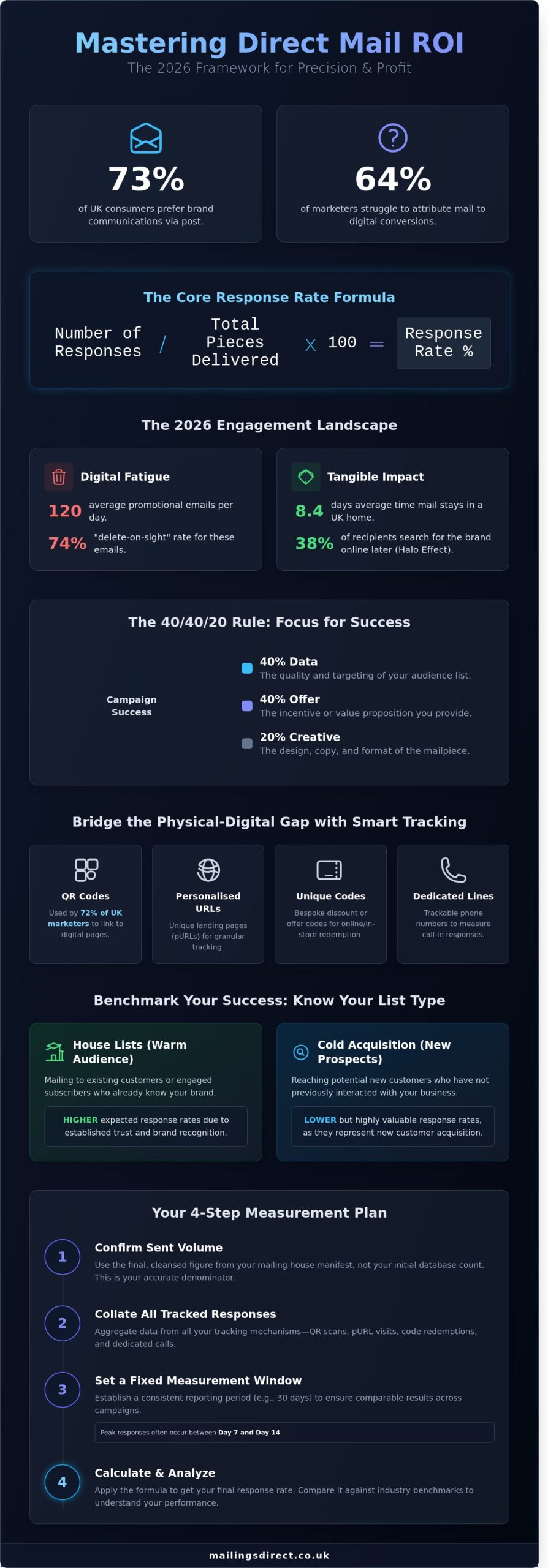
Recent JICMAIL research confirms that 73% of UK consumers prefer brand communications via post, yet 64% of marketing managers still struggle to attribute physical mail to specific digital conversions. You’ve likely felt the impact of rising postage costs and the increasing difficulty of tracking offline leads in a multi-channel environment. It’s a common frustration when you know your campaign has impact but lack the hard data to prove it against cheaper digital alternatives.
This guide introduces our direct mail response rate calculator 2026 framework to help you master your ROI with clinical precision. We provide the professional formulas and industry benchmarks required to set realistic KPIs for your printing and fulfillment projects. We’ll outline exactly how to use data cleansing and smart tracking to lower your cost per response, ensuring your next campaign remains a stable and essential pillar of your business strategy.
Key Takeaways
- Learn how to quantify your campaign success using our direct mail response rate calculator 2026 framework and the essential formula for measuring tangible ROI.
- Compare your results against 2026 UK industry benchmarks to understand how house lists and cold acquisition campaigns should realistically perform.
- Discover the 40/40/20 rule of direct mail to ensure your budget is focused on the data and offers that drive the highest engagement.
- Integrate unique tracking mechanisms like QR codes and pURLs to provide a seamless transition from physical mail to digital action.
- Maximise your marketing budget by utilising professional fulfilment and bulk postage rates to lower the cost per acquisition.
Why Accurate Response Rate Calculation is Critical in 2026
A direct mail response rate is the specific percentage of recipients who take a tracked action after receiving a physical mailpiece. This might involve scanning a QR code, using a bespoke discount code, or visiting a dedicated landing page. In the current UK market, understanding this metric is the difference between a calculated investment and a speculative expense. As we move through 2026, the reliance on a direct mail response rate calculator 2026 has become standard practice for firms seeking to move away from the noise of digital channels. We provide the technical oversight and data precision required to turn these raw numbers into actionable business intelligence.
The standard Direct marketing definition has evolved. It’s no longer just about sending volume; it’s about the precision of the delivery and the accuracy of the subsequent tracking. By 2026, UK consumers receive an average of 120 promotional emails daily, leading to a 74% “delete-on-sight” rate. Physical mail offers a tangible alternative that bypasses digital fatigue. To measure success, businesses must partner with a professional mailing house that handles data cleansing and fulfillment, ensuring the denominator in your calculation is clean, GDPR-compliant, and reachable.
Beyond Vanity Metrics: Linking Response to ROI
Modern UK marketing managers distinguish between a “response” and a “conversion.” A response is an initial enquiry or engagement, whereas a conversion is a completed sale. While a digital campaign might boast a 5% click-through rate, these are often low-intent actions. Conversely, a 1% direct mail response rate frequently delivers a higher return on investment because the physical engagement represents a deeper level of consumer interest. Direct mail also triggers a “halo effect” in 2026; recent data indicates that 38% of recipients who don’t respond directly via the provided code will still search for the brand organically within 48 hours. Using a direct mail response rate calculator 2026 allows you to factor in these nuances to see the true cost per acquisition.
The 2026 Landscape: Physical vs. Digital Engagement
The 2026 consumer landscape shows a distinct preference for physical touchpoints over saturated digital feeds. Tangibility leads to longer brand recall, with physical mail staying in UK households for an average of 8.4 days. This longevity provides multiple opportunities for engagement that a fleeting social media ad cannot match. We ensure that every campaign is backed by high-quality, cleansed data. This reduces wastage and ensures that your response rates aren’t skewed by undeliverable addresses. Precise tracking through integrated technology allows us to provide the end-to-end data necessary for your internal reporting and future strategy planning.
The Direct Mail Response Rate Formula: How to Calculate Your Success
Calculating your campaign’s performance shouldn’t involve guesswork. The fundamental formula for success is straightforward: divide the number of responses by the total number of pieces delivered, then multiply by 100. This provides a clear percentage that serves as your primary performance indicator. When you use a direct mail response rate calculator 2026 model, your accuracy depends entirely on the quality of your input data. If you sent 5,000 items and received 150 responses, your rate is 3%.
You can’t improve what you don’t measure. We recommend implementing unique tracking mechanisms for every campaign to capture every interaction. QR codes are currently used by 72% of UK marketers to bridge the gap between physical mail and digital landing pages. Personalised URLs (pURLs) or dedicated phone lines provide equally granular data. To contextualise your results, you should compare them against DMA direct mail response rate benchmarks, which offer a reliable yardstick for UK industry standards.
Establish a fixed measurement window for every project. While some responses arrive within 48 hours, the peak usually occurs between days seven and 14. Setting a strict 30-day cut-off ensures your reporting remains consistent across different quarters. This timeframe allows for the “pass-along” effect, where mail sits on a kitchen counter or office desk before being acted upon.
Step-by-Step Calculation for Single Campaigns
Start by identifying your “Total Sent” figure. This shouldn’t be your initial database count but the final volume confirmed on your mailing house manifest. Next, collate tracked responses from all channels. If a customer uses a unique discount code over the phone or visits a specific pURL, it counts toward your total. Execute the formula and record this baseline. Having this data allows you to refine your mailing strategy for future campaigns, ensuring your budget is allocated to the most responsive demographics.
Factoring in Data Decay and Delivery Failures
Your calculation’s integrity relies on removing “gone-aways” from the equation. If 5% of your mail is returned as undeliverable, including those pieces in your denominator artificially lowers your response rate. Data cleansing is the process of removing inaccurate records to protect your ROI. Professional data management services are essential for calculation accuracy because they identify deceased records or moved householders before you pay for postage. Using a direct mail response rate calculator 2026 requires this level of precision to ensure your marketing spend delivers the highest possible return.
2026 Benchmarks: What Defines a ‘Good’ Direct Mail Response?
A “good” response rate in 2026 depends heavily on the quality of your data and the relationship you have with the recipient. For house lists, which consist of existing or lapsed customers, we typically see average response rates between 3% and 5%. When you use a direct mail response rate calculator 2026, these are the benchmark figures you should use to model your expected ROI. Cold acquisition lists, where you’re reaching out to prospects for the first time, generally yield lower results, often ranging from 0.5% to 1.5% depending on the niche.
B2B and B2C benchmarks differ because the purchasing logic is fundamentally different. B2C campaigns often capitalise on immediate consumer needs or emotional triggers, leading to faster response times. In contrast, B2B campaigns target professional decision-makers who require more evidence and internal approval. Frequency also plays a vital role in these calculations. Research shows that multiple “touches” are necessary to build trust. Sending a sequence of three mailings rather than a single “one-off” can improve your final response rate by over 20% as your brand gains familiarity. Recent UK direct mail response statistics confirm that physical mail is often revisited multiple times, with 95% of mail being engaged with in some way.
UK Industry-Specific Averages for 2026
Response rates vary significantly across different UK sectors. In 2026, the Retail sector enjoys a healthy 4.2% average, driven by personalised vouchers and seasonal catalogues. Charity Appeals remain the highest performers at 5.1%, as donors respond well to the tactile, emotional storytelling that physical mail provides. Professional Services, such as legal or financial firms, often see lower rates around 2.8%. However, these sectors frequently accept lower response rates because their average order value (AOV) is so high. A single lead in the legal sector can be worth thousands of pounds, making even a 1% response highly profitable. For more detail on how different layouts perform, see our postcard marketing guide.
Format Impact: Postcards vs. Enclosed Letters
The format you choose dictates the initial engagement. Postcards offer an immediate “open rate” of 100% because there’s no envelope to act as a barrier. They’re perfect for quick reminders or flash sales. Enclosed letters, while requiring the recipient to take the extra step of opening them, carry a higher perceived value and provide more space for complex messaging. In 2026, we’ve seen that adding “haptic finishes” like spot UV or soft-touch laminates can boost response rates by up to 15%. These textures trigger a sensory response that digital ads can’t replicate. When you input your data into a direct mail response rate calculator 2026, remember that personalisation—using the recipient’s name and past purchase history—is the single most effective way to move the needle on your results.
Variables That Move the Needle: How to Optimise Your Rates
Achieving a high return on investment requires more than just a large mailing list. Success follows the 40/40/20 rule. This principle dictates that 40% of your success depends on the quality of your data, 40% on the relevance of your offer, and only 20% on the creative design. While the visual elements are what the recipient sees, the data and offer are what drive the numbers in your direct mail response rate calculator 2026.
By 2026, automated workflows have become the standard for high-performing campaigns. These systems trigger mailings based on specific customer behaviours, such as a contract renewal window or an abandoned online basket. This level of precision ensures your message arrives exactly when the recipient is ready to buy, significantly boosting your conversion stats compared to generic “batch and blast” methods.
A/B testing provides the only reliable way to refine your approach. Don’t guess which headline works best. Instead, send two variations to small segments of your list. By comparing the results, you can identify which “Big Three” variable needs adjustment before committing to a full-scale print run. This scientific approach removes the risk and ensures your budget is spent on proven strategies.
The Power of Data Cleansing and GDPR Compliance
Every undelivered letter is a direct hit to your profit margin. Professional cleansing services remove duplicates and deceased records, which can account for up to 12% of an unmaintained database. GDPR compliance remains a critical legal requirement in 2026. Maintaining a clean list protects your brand reputation and prevents the financial drain of postage waste. Clean data typically reduces campaign costs by 15%, immediately improving your cost-per-response.
Creative Design and the Tangibility Factor
Tangibility is your greatest asset in a crowded digital marketplace. A physical piece of mail stays in a UK household for an average of 8.5 days, providing multiple opportunities for engagement. Use high-impact full-colour litho printing to establish immediate brand authority. For luxury sectors, bespoke hand-fulfilment or heavy-weight cardstock increases the perceived value of your offer. Clear, trackable CTAs like personalised QR codes are essential for feeding accurate data back into your direct mail response rate calculator 2026.
Ready to reduce your campaign waste and improve your ROI? Get a professional postage audit to identify immediate cost savings for your next mailing.
Scaling Your Results with Professional Fulfilment and Bulk Postage
Scaling a direct mail campaign requires a shift in focus from simple delivery to industrial efficiency. Manual, in-house mailing might work for a few hundred items, but it becomes a bottleneck when you aim for thousands. Professional mailing houses remove this friction by using high-speed automated enclosing machines. These systems process thousands of items per hour with 100% accuracy, ensuring that every envelope contains the correct inserts. This transition from manual labour to automation significantly reduces the “Cost” side of your ROI equation, allowing your budget to stretch much further.
We act as your technical partner, handling the heavy lifting of postage sortation and logistics. By removing the complexity of Royal Mail regulations and data management, we allow your team to focus on strategy rather than envelope stuffing. Efficiency is the foundation of a successful 2026 strategy. When you use a direct mail response rate calculator 2026, you’ll notice that even a small reduction in unit cost can lead to a dramatic swing in your final profitability figures.
Leveraging Wholesale Postage Rates and DSA
Postage is often the largest single expense in any campaign, frequently accounting for over 50% of the total spend. We utilise Downstream Access (DSA) to bypass standard retail channels. This involves pre-sorting your mail and injecting it directly into the postal network, which provides significant savings over standard Royal Mail rates. Mailsort preparation can slash your postage costs by up to 30%, depending on the volume and density of your data. These savings are transformative; they allow you to send more pieces for the same initial budget, effectively increasing your total number of responses without increasing your spend.
Seamless End-to-End Campaign Management
Working with a one-stop shop for printing, data, and fulfilment eliminates the risks associated with multi-vendor logistics. We provide a “safe pair of hands” approach that covers everything from GDPR-compliant data cleansing to high-quality litho printing and professional envelope addressing. This unified process ensures a premium first impression for your recipients, as every element of the mail pack is aligned and professionally finished. Our end-to-end service removes the risk of costly mailing errors, such as incorrect postage marks or data mismatches, which can ruin a campaign’s effectiveness. You can get a bespoke quote for your 2026 campaign to see how our integrated approach can optimise your direct mail response rate calculator 2026 projections and deliver a reliable, cost-effective result.
Turn Your 2026 Direct Mail Strategy into Results
Achieving a high response rate in 2026 requires more than just a compelling offer. It demands absolute precision in your data and total efficiency in your physical logistics. Since 2005, Mailings Direct has provided UK businesses with a reliable, safe pair of hands for their most complex mailing campaigns. Using a direct mail response rate calculator 2026 helps you set clear benchmarks for success; however, the real value comes from expert execution.
We handle everything from specialist GDPR-compliant data cleansing to high-capacity industrial fulfilment, ensuring your message reaches the right door at the most competitive price. Our access to discounted bulk postage rates through Downstream Access (DSA) means your marketing budget works harder, often reducing postage costs by up to 30% compared to standard rates. You don’t need to navigate the technical complexities of the postal system alone. We provide a seamless, end-to-end service that turns complex logistics into tangible business growth. Let’s get your next campaign moving.
Calculate your next campaign costs with a Mailings Direct quote
Frequently Asked Questions
What is a good direct mail response rate for UK businesses in 2026?
A good direct mail response rate for UK businesses in 2026 typically ranges from 3.5% to 5% for prospect lists and up to 12% for existing customer mailings. These figures remain strong as physical mail provides a tactile alternative to crowded digital inboxes. Using a direct mail response rate calculator 2026 helps you forecast these benchmarks based on your specific sector data and historical performance.
We’ve observed that campaigns incorporating personalised elements see a 15% increase in engagement compared to generic mailshots. Achieving these targets requires high-quality data and a clear call to action. We provide the technical expertise to help you hit these KPIs through precision targeting and professional fulfillment services.
How do I track direct mail responses if I don’t have a website?
You can track responses effectively by using dedicated telephone numbers or unique physical coupon codes. Assigning a specific phone extension to your mailing allows you to monitor inbound enquiries with 100% accuracy. Another reliable method involves including a perforated voucher that customers must return in-person to claim a discount or offer.
One local retail client tracked 450 physical redemptions from a single 5,000-piece campaign using this exact method. You can also use “refer a friend” cards with unique identifiers to track word-of-mouth growth. These offline tracking methods ensure you can calculate your return on investment without needing a complex digital infrastructure.
Does the size of the postcard affect the response rate?
Larger formats like A5 or DL often achieve a 20% higher response rate than standard A6 cards because they offer greater visibility in a stack of mail. While the unit cost for printing and postage may be slightly higher, the increased engagement usually justifies the spend. Data from 2025 campaigns shows that oversized postcards generate 3.9% more initial interest from recipients.
We recommend balancing the physical size with the weight of the card stock to stay within specific Royal Mail weight brackets. A heavier 350gsm A5 card feels more premium and professional than a thin A6 flyer. This tactile quality builds immediate trust and encourages the recipient to keep the mailpiece for longer.
How much does data cleansing typically cost for a UK mailing list?
Data cleansing typically costs between £15 and £30 per 1,000 records depending on the complexity of the audit required. This process involves cross-referencing your list against the Mailing Preference Service and deceased records to ensure you aren’t wasting budget on undeliverable mail. Investing in this service can reduce your total postage waste by up to 12%.
We provide a comprehensive data audit before every campaign to ensure your list is GDPR compliant and accurate. Removing “gone-aways” and duplicate entries protects your brand reputation and improves your overall response statistics. It’s a vital step for any business looking to maintain a cost-effective and professional direct mail strategy.
Can I use a direct mail calculator for charity appeal campaigns?
You can use a direct mail response rate calculator 2026 to model charity appeals by focusing on average gift values and donor acquisition costs. Charities often see higher-than-average response rates of 4.5% when mailing warm donor lists. The calculator helps you determine the break-even point by comparing the total print and postage costs against the projected donation totals.
This tool is essential for planning seasonal appeals where ROI is measured by the lifetime value of a new supporter. We handle the entire process from litho printing your appeal letters to managing the final sortation. This end-to-end service ensures your fundraising budget is used efficiently to reach the right donors at the right time.
What is the difference between response rate and ROI?
Response rate measures the percentage of people who took action, while ROI calculates the actual profit generated after all campaign costs are deducted. If you send 1,000 letters and 50 people respond, your response rate is 5%. However, your ROI depends on whether the revenue from those 50 customers exceeds the total cost of the mailing.
A campaign can have a high response rate but a low ROI if the cost per acquisition is too high. Conversely, a low response rate on a high-ticket item can still result in a massive ROI. We focus on both metrics to ensure your marketing spend delivers a tangible financial result for your business.
How does Royal Mail sortation affect my campaign costs?
Royal Mail sortation can reduce your postage costs by up to 30% because it simplifies the delivery process for the carrier. By pre-sorting your mail into specific postcode areas and containers, you qualify for lower Advertising Mail or Business Mail rates. This requires specialist software and a deep understanding of current postal regulations.
We manage this technical process in-house to ensure your mailings meet the strict criteria for maximum discounts. This “safe pair of hands” approach removes the complexity of postal logistics for our clients. The savings gained from sortation often allow businesses to increase their total mail volume without increasing their overall budget.
Is direct mail still more effective than email in 2026?
Direct mail remains highly effective with average open rates of 90%, whereas marketing emails often struggle to exceed 22%. Physical mail stays in a household for an average of 7.2 days, providing multiple touchpoints that digital ads simply can’t match. Research shows that consumers spend 28% more time engaged with physical mail than they do with digital marketing.
While email is cheaper for high-frequency messaging, the tactile nature of a letter builds 40% more brand recall. Most successful UK businesses now use an integrated approach, using mail to drive high-value conversions. We help you bridge this gap by producing high-impact physical mail that cuts through the digital noise.