
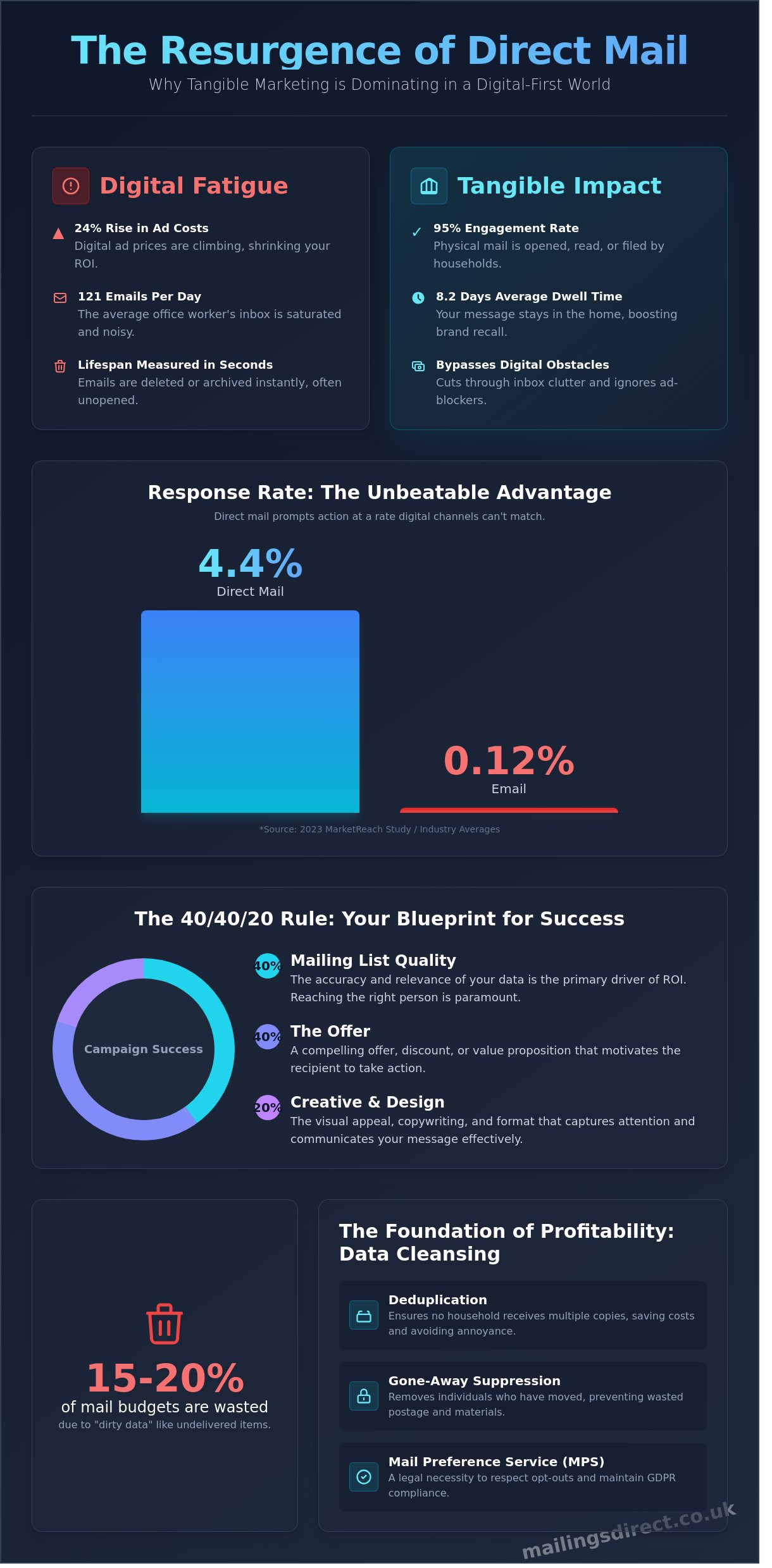
While digital ad costs on platforms like Meta rose by 24% in late 2024, physical mail achieved a consistent 95% engagement rate according to JICMAIL data. You’ve likely noticed that your marketing emails are hitting “Promotions” folders or simply being deleted before they’re even opened. It’s frustrating to watch your customer acquisition costs climb while your brand message disappears into a crowded inbox. This is why direct mail advertising remains an essential pillar of a stable marketing strategy. It offers a tangible, high-impact alternative that demands attention on the doormat and delivers a memorable brand presence that digital pixels cannot match.
You need a reliable way to reach your audience without the stress of complex postal regulations or the rising price of digital clicks. We’ll show you how modern litho printing and precise data cleansing can transform your ROI. This article outlines the specific strategies, examples, and end-to-end fulfilment processes you need to deliver seamless, cost-effective campaigns across the UK in 2026.
Key Takeaways
- Understand why direct mail advertising is regaining dominance in the UK by overcoming digital fatigue and achieving significantly higher household dwell times.
- Master the 40/40/20 rule to ensure your campaigns prioritise high-quality data and compelling offers to drive maximum engagement.
- Identify the most cost-effective formats for your specific goals, ranging from high-impact brochures to streamlined postcards that deliver measurable ROI.
- Learn how to bridge the gap between physical mail and digital sales funnels using modern, response-driven design and copywriting techniques.
- Discover the logistical advantages of using a professional mailing house to handle end-to-end fulfilment while securing the best possible postage rates.
The Resurgence of Direct Mail Advertising in a Digital-First World
Direct Mail Advertising involves the delivery of physical marketing materials to a specific, targeted audience at their home or business address. While digital channels have become increasingly saturated, physical mail offers a tactile alternative that demands attention. In 2024, data from JICMAIL revealed that the average piece of direct mail remains in a UK household for 8.2 days. This “dwell time” provides a level of exposure that digital ads cannot match. Consumers now face “digital fatigue,” with the average UK office worker receiving 121 emails daily. Physical mail cuts through this noise by providing a sensory experience that digital screens lack.
Reliable data cleansing plays a vital role in this resurgence. By removing deceased records and gone-aways, businesses ensure their communications are welcome rather than intrusive. This precision reduces waste and maintains GDPR compliance, which is essential for protecting brand reputation. When mail is relevant and accurately addressed, it transforms from “junk” into a useful service or offer. We provide these technical fulfillment services to ensure every campaign reaches the right hands without unnecessary cost.
Why Physical Mail Beats Digital Clutter in 2026
Email marketing often suffers from a lifespan measured in seconds. Most promotional emails are deleted or archived without being opened. In contrast, a well-designed postcard or brochure often finds a place on a kitchen counter or mantelpiece. This physical presence builds a trust factor that social media ads lack. A 2023 MarketReach study found that 71% of UK consumers trust mail more than digital advertising. Physical mail bypasses ad-blockers and congested inboxes, delivering your message directly into the hands of your target demographic.
The “Tangibility Effect” on Consumer Behaviour
Physical touch enhances brand recall and emotional connection. Research into sensory marketing suggests that the act of holding a physical object creates a deeper memory trace than viewing a flat image on a screen. High-value sectors like luxury goods, charities, and professional services benefit most from this format. The texture of the paper and the weight of the cardstock signal quality and stability. Choosing a 400gsm silk finish for a brochure conveys a sense of premium value that a standard PDF cannot replicate. This tangibility drives action, with direct mail advertising often prompting a 4.4% response rate compared to the 0.12% average for email campaigns.
Core Components of a High-Response Direct Mail Campaign
Successful direct mail advertising hinges on the 40/40/20 rule. This industry framework dictates that 40% of your campaign’s success depends on the quality of your mailing list, 40% on the strength of your offer, and only 20% on the creative design. Even a visually stunning brochure fails if it reaches a recipient who moved house three years ago or has no interest in your sector. Accuracy is the primary driver of ROI; sending 5,000 perfectly designed letters to the wrong demographic is simply an expensive way to fill recycling bins.
UK businesses must adhere to strict legal frameworks to maintain brand reputation. Following the ICO’s direct marketing guidance ensures your campaign remains compliant and ethical. This involves balancing legitimate interest with the recipient’s right to privacy. Modern personalisation now goes beyond “Dear [Name]” tags. It uses variable data printing to alter entire paragraphs, images, and offers based on a recipient’s previous purchase history or specific location, creating a truly bespoke experience.
Data Cleansing: The Foundation of Profitability
Data cleansing is the systematic removal of incorrect or outdated information from a mailing list. Dirty data causes an average of 15% to 20% wastage in mail budgets due to undelivered items and wasted postage. We recommend a rigorous process involving deduplication to ensure no household receives multiple copies, and gone-away suppression to remove individuals who have moved. Cross-referencing your list against the mail preference service is a legal necessity that prevents you from contacting people who have opted out of physical marketing. Our team can help you audit your current database to identify these hidden costs before you hit the print room.
The Big Three: Data, Offer, and Creative
Maximising relevance requires deep audience segmentation. B2B campaigns often segment by industry sector or job title, whereas B2C campaigns might focus on life stages, such as new homeowners or retirees. Once you have identified the “who,” you must craft a “hard-to-refuse” offer. A generic 5% discount rarely justifies the physical interaction a letter demands. Instead, consider high-value propositions like a free physical sample, a time-limited 25% “welcome back” voucher, or an exclusive invitation to an in-store event.
The creative element must then guide the recipient toward a clear, actionable goal. Your design should balance brand aesthetics with functional response triggers. Effective direct mail advertising in 2026 often uses QR codes to bridge the gap between physical and digital, leading recipients to personalised landing pages. Ensure your call to action is prominent and easy to follow; if the recipient has to guess how to redeem your offer, the campaign has already failed. This methodical approach ensures every penny of your postage budget works toward a measurable conversion.
Direct Mail Advertising Examples: Formats that Deliver ROI
Selecting the right format for your direct mail advertising campaign determines your total cost per acquisition. High-quality, full-colour printing is a non-negotiable standard for 2026. It ensures your brand looks professional and maintains credibility when it lands on a doormat. Your choice of format influences everything from the initial “thud factor” to the final postage bill, so matching the vehicle to the objective is vital for success.
Postcard Marketing: High Impact, Low Cost
Postcards represent the most efficient way to send mail for time-sensitive promotions. Because there’s no envelope to open, your message is delivered instantly the moment the recipient picks it up. This “no-envelope” advantage is perfect for retail sales or local service reminders where a quick visual hook is required. You can find more detail in our parent pillar on postcard marketing. Postcards typically qualify for the lowest postage tiers, often saving UK businesses up to 22% compared to heavier, enclosed formats. They’re fast to produce, allowing for rapid deployment of tactical marketing messages.
Personalised Letter Packs and Charity Appeals
A traditional letter pack remains the gold standard for complex storytelling and building trust. These packs usually consist of a printed outer envelope, a personalised letter, a supporting brochure, and a response device. UK charities frequently rely on this format because it provides the space needed for emotional narratives that drive high-value donations. For bespoke “VIP” campaigns targeting high-net-worth individuals, we often recommend hand fulfilment. This manual process adds a tactile, human touch that automated machines cannot replicate. While the production cost is higher, the precision of a hand-matched letter and envelope often results in a 4.5% increase in response rates for luxury brands and non-profits.
Polywrapping for Brochures and Catalogues
Polywrapping involves wrapping your mail in a protective, lightweight film. It’s the industry standard for high-page-count items like catalogues, magazines, or bulky brochures. This method offers several distinct advantages for high-volume direct mail advertising:
- Weight Savings: Polywrap is significantly lighter than paper envelopes. This often keeps a mailing within a lower Royal Mail weight band, reducing postage costs by thousands of pounds on large runs.
- Protection: The film keeps your catalogues dry and undamaged during the delivery process.
- Branding: You can choose clear film to let your cover design do the heavy lifting, or printed film to include additional marketing messages before the pack is even opened.
We typically recommend machine enclosing for large-scale runs of 5,000 units or more to ensure maximum speed and efficiency. If your campaign involves multiple inserts or irregular shapes, manual assembly provides the necessary control to ensure every recipient receives a perfect package.
Designing for Response: Bridging the Physical-Digital Gap
Successful direct mail advertising in 2026 functions as a high-conversion entry point for your digital sales funnel. It is no longer a standalone medium; it’s the starting point of a multi-channel journey. To ensure this transition is successful, your design must prioritise a clear visual hierarchy. A cluttered layout creates mental friction, whereas a design that utilises roughly 30% white space allows the recipient’s eye to land on the core message immediately. JICMAIL 2023 research shows that mail is interacted with 4.1 times on average. This means your piece must be scannable so the value proposition remains clear even during a five-second glance on the way from the letterbox to the kitchen counter.
QR Codes and Digital Bridges
QR codes provide the most efficient way to track response rates in real-time. By integrating a dynamic QR code, you can monitor exactly when and where your audience is engaging. For high-value campaigns, pURLs (Personalised URLs) offer a superior experience. A bespoke link like brand.co.uk/james-wilson makes the recipient feel valued and streamlines the conversion process. Always place your QR code in a prominent, easy-to-scan position. Ensure it’s at least 20mm in size to avoid technical failures that frustrate potential customers.
Copywriting for Tactile Engagement
Your copy needs to be direct and functional. The headline on your envelope or postcard front determines whether the piece is opened or recycled. It must promise a solution or a tangible benefit. Once the recipient is reading, the P.S. line becomes your most valuable real estate. Industry data suggests the P.S. is one of the most read sections of any marketing letter. Use it to reinforce your deadline or a specific offer. Keep your Call to Action (CTA) singular and unmistakable. Whether you want them to claim a £25 discount or book a consultation, don’t confuse the reader with multiple choices.
Effective direct mail advertising relies on precision and professional execution to ensure your physical assets drive digital results. If you’re ready to launch a campaign that delivers measurable ROI, we can provide a bespoke direct mail solution tailored to your specific business goals.
Navigating UK Logistics: The Professional Mailing House Advantage
While small, local mailings might seem manageable at a desk, the economics shift dramatically once a campaign exceeds 500 items. Handling direct mail advertising in-house often leads to hidden costs in staff time and retail postage rates. A professional mailing house removes these inefficiencies by consolidating design, print, and distribution under one roof. This end-to-end approach ensures that technical specifications for litho or digital printing align perfectly with postal requirements, preventing costly errors before the first sheet hits the press.
Data security is a non-negotiable priority for UK businesses in 2026. Managing sensitive customer information requires more than a simple spreadsheet. Professional partners provide a secure environment for data cleansing and processing, ensuring every campaign remains fully GDPR compliant. They act as a safe pair of hands, shielding your brand from the legal and reputational risks associated with data breaches or mismanaged mailing lists. We handle the complex logistics of Royal Mail’s ever-changing regulations, so you don’t have to worry about surcharges or rejected batches.
Postage Savings through Mailsort and DSA
Royal Mail offers substantial discounts to those who do the heavy lifting of sorting mail before it reaches the delivery office. Professional mailing houses use advanced software to organise items by postcode through Mailsort; this reduces the manual labour required by the postal service. Additionally, Downstream Access (DSA) allows private carriers to handle the initial transport of mail, only handing it to Royal Mail for the “final mile” delivery. Professional mailing houses can often save clients up to 30% on postage costs through advanced sortation technology. These savings frequently outweigh the service fees, making professional fulfilment more affordable than DIY methods.
End-to-End Fulfilment and Quality Control
The journey from a digital file to a physical letterbox involves complex logistics. High-speed machine enclosing technology ensures that every envelope contains the correct inserts at speeds of up to 10,000 items per hour. This level of precision is impossible to replicate manually. We manage the entire lifecycle of your assets, from initial print runs to final delivery at the sorting office. This methodical process provides total visibility and control over your campaign, ensuring your direct mail advertising arrives on time and in pristine condition.
- Data Cleansing: Removing duplicates and deceased records to prevent wasted spend.
- Machine Enclosing: Rapid, accurate insertion of multiple items into envelopes.
- Postal Optimisation: Selecting the most cost-effective carrier for your specific volume and timeline.
Choosing a professional partner means you’re investing in reliability. We provide the industrial capacity needed for large-scale campaigns while maintaining the attention to detail that a bespoke project requires. It’s a pragmatic choice for any business manager who values results over the stress of managing complex postal logistics internally.
Future-Proof Your Marketing Strategy for 2026
As digital channels become more crowded, direct mail advertising provides a physical touchpoint that digital ads can’t replicate. Success in the 2026 landscape depends on bridging the gap between tactile mail and digital conversion through smart design and precise logistics. Mailings Direct offers over 20 years of UK mailing expertise to help you navigate these complexities with confidence. We provide a complete end-to-end service, covering everything from litho printing to final postage distribution across the country.
Our team handles the technical heavy lifting, including GDPR-compliant data management and thorough data cleansing to ensure your budget isn’t wasted on undeliverable addresses. By leveraging our established relationships with postal carriers, we secure the most cost-effective rates for your business. We’ve built our reputation on being a safe pair of hands, delivering reliable results that cut through the noise. It’s time to put your brand directly into your customers’ hands with a campaign that’s built for response and designed for reliability.
Get a bespoke quote for your next direct mail campaign today
We look forward to helping you deliver a campaign that achieves your commercial objectives with total precision.
Frequently Asked Questions
Is direct mail advertising still effective in 2026?
Direct mail advertising is highly effective in 2026, with 88% of UK consumers reporting they trust physical mail more than digital adverts. While digital channels suffer from 40% ad-blocker usage, physical mail achieves a 94% open rate. We provide tangible touchpoints that cut through digital noise. It’s an essential part of a multi-channel strategy that builds lasting brand recall through physical interaction.
How much does a typical direct mail campaign cost in the UK?
A typical direct mail campaign in the UK costs between £0.50 and £1.20 per unit for a standard 5,000-item run. This price includes data cleansing, litho printing, and postage. We handle the entire process to drive down costs. By using our wholesale postage rates, businesses often save 25% compared to standard Royal Mail prices. We provide clear, transparent quotes to ensure your budget is managed efficiently.
What is the average response rate for direct mail advertising?
The average response rate for direct mail advertising sits at 9% for house lists and 5% for prospect lists. This significantly outperforms email marketing, which currently averages a 1% click-through rate in 2026. High-quality fulfillment and personalised messaging ensure your campaign reaches the right hands. We use data-driven targeting to maximise these returns for every client. Our focus remains on delivering measurable results for your marketing spend.
How do I ensure my direct mail campaign is GDPR compliant?
We ensure GDPR compliance by conducting rigorous data cleansing and using Legitimate Interest as the legal basis for B2B mailings. Every campaign we handle follows the Data Protection Act 2018 guidelines strictly. We screen all lists against the Mail Preference Service (MPS) to remove 100% of opted-out households. This protects your brand reputation and avoids potential fines. Trusting a safe pair of hands ensures your data remains secure.
What is the minimum volume for a bulk mail discount?
The minimum volume to qualify for bulk mail discounts through Royal Mail Wholesale is 4,000 letters or 1,000 large letters. We aggregate smaller volumes to help SMEs access these reduced rates. Our end-to-end service ensures your mail is sorted and presented correctly to meet these strict postal requirements. This approach secures the most cost-effective distribution for your business. We manage the technical logistics so you don’t have to.
How can I track the ROI of my physical mail campaign?
You can track the ROI of your physical mail campaign by using unique QR codes, dedicated landing pages, or bespoke discount codes. In 2026, 72% of successful campaigns use these digital bridges to monitor real-time conversions. We provide the technical expertise to integrate these tracking elements into your design. This data allows you to measure your exact return on investment. It turns a traditional medium into a fully trackable digital asset.
What is the difference between a mailing house and a printer?
A printer focuses solely on the physical production of your assets, whereas a mailing house provides an end-to-end service including data management and postage. We act as a one-stop shop that handles litho printing, envelope stuffing, and final delivery. Choosing a specialist mailing house simplifies your logistics and typically reduces total project costs by 15% through integrated workflows. We remove the stress of coordinating multiple different suppliers.
Can direct mail work for B2B companies or is it just for B2C?
Direct mail works exceptionally well for both B2B and B2C companies, with B2B mailings seeing a 23% higher engagement rate than digital outreach. For B2B, physical mail lands directly on a decision-maker’s desk, bypassing crowded email inboxes. We deliver bespoke campaigns that tailor the format to your specific audience. It’s a reliable way to secure high-value contracts in a competitive market. Our pragmatic approach ensures your B2B message carries weight and authority.